5th Sunday of Lent, Cycle C (2)

We’re two weeks away from Easter Sunday, and, as Paul describes in today’s Second Reading, we must forget what lies behind and strain toward what lies ahead. Our Lord wants to create something new in us during these last days of the Lenten season, and requires leaving some things behind.

In today’s First Reading we’re reminded by Isaiah that the past of slavery to sin and distress in the desert is being left behind to pave the way for something new. He starts by recalling the escape through the Red Sea that meant liberation for the Israelites, “the people whom I formed for myself,” and destruction for the Egyptians, “a powerful army.” As the story of Exodus would later reveal, the Israelites still thought of returning to Egypt often, tired of hardship in the desert. They were willing to sacrifice their new-won freedom just to avoid discomfort.

The Lord today encourages them and tells them the desert itself is being transformed. This is something new, created by Our Lord. Even in the desert signs of hope begin to appear. Lent is like a hard journey through a desert, but the desert also represents our earthly life, plagued by difficulties, temptations, and trials. Our life here and now has been transformed into something new by Our Lord’s victory over sin and death. We just have to leave sin behind and strain toward what he offers us.

In today’s Second Reading St. Paul describes well what how should consider anything in our lives, past, present, or future, that don’t lead us to Christ: refuse. Even the great St. Paul in his earthly life didn’t see his work of answering Christ’s call as done. He knew Christ was calling him to something greater, but he had not yet attained it. Paul “strained” toward what lay ahead; that meant he put his whole self into it.

In Lent we strain as well, striving to go above and beyond our normal spiritual life so that we draw closer to Christ and truly grow spiritually. We don’t just strain because pushing ourselves any harder is beyond our abilities; we also strain because of the weight of what we cannot leave behind: our old life of sin and selfishness. That’s why Paul doesn’t mince words when he labels those things as “refuse.” We must leave them behind and forget them so that we can move forward.

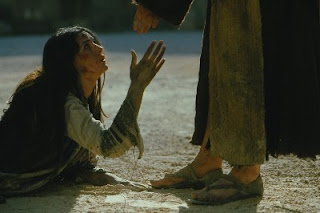
In today’s Gospel we’re reminded in the story of the woman caught in adultery that the opportunity to strain ahead and let Our Lord created something new in our lives is also thanks to his mercy. The Lord helps us know what we truly must leave behind, even at times when we don’t see it. The scribes and Pharisees are looking for a trial, and they have the criminal who was caught in flagrante delicto and the Law on their side. The adulteress knows that too, which is why she is silent. She knew her fate was now out of her hands.

The Law prescribed that a just man to pronounce sentence on her. When they invited the just man, Jesus, the man without sin, to come forward and throw the first stone, they found themselves on trial too. They’d only come to trap Jesus in the situation, to put him on trial. They weren’t really seeking justice. They came to him as if they considered him a just man, but their actions showed they were sinners just like the woman they were condemning. They wanted a rubber stamp or a political scapegoat, not justice, and so Our Lord revealed to them that they were the most unjust of men, and they skulked off, one by one, until only the adulteress remained, alone before the only just person who could pronounce a verdict.

We stand alone with God. The other voices, one by one, leave and attend to their own consciences, knowing that they can only judge themselves so much before the case comes to the Divine Judge. In the end we too will stand speechless and hopeful for mercy, just like the adulteress. Ashamed and silent, sorry for what we have done, we must stand before Jesus and answer for it in the light of day.

Each “jury” member that had been united around condemning another walked off alone. No one wanted to face up to Jesus for what they had done; they changed their vote with their feet. The adulteress was ready to accept her judgment. Jesus confirmed the jury’s revised verdict: since they had un-decided to condemn her, he would not condemn her either, but he also told her the truth about herself, just like he always does in each of our hearts: “Go, and from now on do not sin any more.”

What are you having a hard time leaving behind? Today’s readings remind just that Lent is not just a time for easing off on things we normally do, but a time for leaving things behind that prevent our spiritual growth. Your Lenten resolutions, if properly chosen, help you to see the things you must leave behind to strain toward a deeper friendship with Christ. It may take a long time to leave something behind, but with Our Lord’s help, you will.

Readings: Isaiah 43:16–21; Psalm 126:1–6; Philippians 3:8–14; John 8:1–11. See also 5th Sunday of Lent, Cycle C.
4th Sunday of Lent, Cycle C (2)

We are just past the half-way point in Lent. Jesus is heading to Jerusalem for the last time, and Easter is a light on the horizon, because we live Lent with Easter in mind. The message for this Sunday is on the lips of St. Paul in today’s Second Reading: “We implore you on behalf of Christ, be reconciled to God.”

In today’s First Reading the Lord tells Joshua that the forty years that Israel spent in the desert, due to their rebellion rebelling against him, are over. The Israelites have just entered the Promised Land, and for the first time in forty years they eat the Passover meal using the food of the Promised Land instead of manna, a fine powder God gave them each day in the desert to bake into bread: “a fine, flake-like thing, fine as hoarfrost on the ground” (Exodus 16:14). The Israelites spent had forty years in the desert, suffering and toiling, to reconcile with God after they mistrusted him and complained against him. They have finished their time of penance, which is why God tells them: “Today I have removed the reproach of Egypt from you.” Every time they grumbled and complained, they resented leaving Egypt. Egypt symbolized strange gods, evil customs: in a word, sin. Through forty years of penance the Israelites had reconciled themselves with God.

The sacrament of Confession, the Catechism tells us, “is called the sacrament of Reconciliation, because it imparts to the sinner the love of God who reconciles: ‘Be reconciled to God.’ He who lives by God’s merciful love is ready to respond to the Lord’s call: ‘Go; first be reconciled to your brother’” (CCC 1424). Reconciliation with God and reconciliation with each other go hand in hand. At the start of each celebration of the Eucharist, we pray in the Penitential Rite, confessing our sins to God and our brothers and sisters and asking each other to pray to God that we might be forgiven for our sins. We know that we have reconciled with God, and received his love again, when we are willing to reconcile with others. John in his first letter says anything else is a lie: “We love, because he first loved us. If any one says, ‘I love God,’ and hates his brother, he is a liar; for he who does not love his brother whom he has seen, cannot love God whom he has not seen” (1 John 4:19-20).

Today’s Gospel, in the parable of the Prodigal Son, a moment to be reconciled is at hand for the whole family. We don’t need to do much moral math to see that the Prodigal Son blew it and is sorry. At first it seems he is just sorry that he doesn’t have anything else to eat, due to using up all his father’s money and then being in a famine, but when he comes back home, he has his lines all rehearsed: “Father, I have sinned against heaven and against you. I no longer deserve to be called your son; treat me as you would treat one of your hired workers.”’ He barely says the words before his father gives him a big hug and calls for him to be dressed again as his son should be, and to throw a big feast. In an instant he goes from starving pig herder to a re-birthday party.

The tougher case that sometimes we overlook is the older brother; he couldn’t believe what his little brother did, but he was even more confused over what his father did. In his words to his father we see there is some resentment, not only toward his younger brother, but toward his father. This bears the risk of leaving the older brother outside in the cold: he doesn’t want to reconcile with his father, nor with his brother. The parable doesn’t say how the older brother reacted to his father’s words. If we feel like the older brother sometimes, this leaves the story open to a happy ending or sad one.

Let’s spend the last few weeks of Lent reconciling with God and with others in order to have a truly happy ending to our story. The drama between the loving Father, the younger wastrel of a son, and the angry older brother is a parable of God the Father’s mercy, but it is also not far from the drama of many estranged families today. Reconciliation with God and reconciliation with others goes hand in hand. Lent is a time of reconciliation, even when that reconciliation is painful, as Our Lord teaches us on Calvary. Like the Father in todays parable, God didn’t have to reconcile with us, because he did nothing wrong. Yet he did, in his Son. If you are experiencing the drama in your own life of being estranged from someone, even if you were not at fault, take the first step this Lent toward reconciliation, in imitation of Our Lord.

Readings: Joshua 5:9a, 10–12; Psalm 34:2–7; 2 Corinthians 5:17–21; Luke 15:1–3, 11–32. See also 4th Sunday of Lent, Cycle C, 31st Week in Ordinary Time, Thursday and 2nd Week of Lent, Saturday.

3rd Sunday of Lent, Cycle C (2)

We have almost reached the half-way point to Calvary. The forty days of Lent remind us of the forty days in the desert. We’ve spent a few weeks in the desert, living our Lenten resolutions, and maybe our stomachs, or spirits, are starting to grumble for those things we’ve left behind for these forty days. How are our Lenten resolutions holding up? The Lenten resolutions are how we enter the desert. If you haven’t giving anything up for Lent yet, it’s not too late, but once in the desert, you must stay the course to reach the Promised Land.

As today’s First Reading reminds us, God is never indifferent to our struggles. When Moses asks God how he should identify him to the Israelites, suffering under bondage in Egypt, God tells them, “tell them I AM has sent you.” God is always there. He doesn’t just stop with that: he reminds them he is the God of Abraham, Isaac, and Jacob to remind them that he is always faithful to his promises. He promised Abraham land and countless descendants if he had faith. Isaac was the fulfillment of that promise, and then Jacob became the father of the twelve tribes of Israel. Despite this, when Pharaoh let Moses lead Israel out into the desert, they had forty years of wandering before they entered the Promised Land—and many never made it.

In today’s Second Reading St. Paul reminds us that all the Israelites in the Exodus received the same gifts from God, but many didn’t stay the course out of evil desires. Their forty years in the desert were due to a lack of trust in God. The Lord had taken them straight to the Promised Land, but they were too scared to enter. They put their trust in food and water (and God sent them dew and manna, and quail to eat), ceremonies (trying to set up worship apart from Moses), authority and rumor mongering (asking why Moses should be the only one to speak on their behalf) – and they perished. Our Lord doesn’t mince words in today’s Gospel about how we can stay the course in the desert. We’re guilty many times of the same thing as the Israelites. We don’t understand that the desert is a place for God to purify the hearts of those he loves, away from distractions. There are far fewer distractions in the desert, but the rumbling of our stomachs is also louder, teaching us what we’re truly hungering.

Today’s Gospel shows the Jews in a drought of hope. Pilate has slaughtered a group of Galileans as they were offering worship. The Jews ask Jesus why. Why would God allow such as thing? Jesus adds an accident to the list of doubts: eighteen dead in a tower collapse in Siloam. Our Lord’s words are far from comforting: his listeners are in the same danger, and so are we. Staying the course doesn’t mean not taking risks or making sacrifices (that wouldn’t have saved the Galileans), nor does it mean getting lucky (that wouldn’t have saved the people crushed in Siloam); staying the course means putting your trust in God and showing it.

We show our trust by bearing fruit. Fruit? In a desert? We are in a desert, and God wants us to bear fruit. We bear fruit by trusting in God’s patience with us (in the parable he gives the fig tree four chances to get its act together), and, as Jesus tells us, by repentance. Lent is about repentance, not just for our sins, but for the sins of the whole world. The Church teaches us three ways to prepare fertile and fruitful soil: fasting, prayer, and almsgiving.

Penance prepares the soil, but the sacraments are how we draw close to Christ and the Holy Spirit. Jesus waters the soil with his own blood so that we can bear fruit. The Eucharist gives us strength for the journey, and the sacrament of Reconciliation puts us back on our feet and turns us back in the right direction. The fruits of the Spirit will come, as Scripture reminds us: charity, joy, peace, patience, kindness, goodness, generosity, gentleness, faithfulness, modesty, self-control, and chastity. By repentance and the sacraments we gain the strength to bear these fruits. Otherwise, we’ll lose our bearings and never get out of the desert.

In today’s Second Reading St. Paul gives a good piece of advice to those who are spiritually presumptuous: “whoever thinks he is standing secure should take care not to fall.” Life is an exodus and a desert. Through Baptism we’ve left the slavery of sin (Egypt) behind, and the world may materially present itself as a potential oasis, but in faith we know everything in it is fleeting compared to the Promised Land of Heaven. Are you taking a direction in your life that is headed toward Heaven or are you content with wandering around in the desert? The Lord will lead you to the Promised Land if you let him.

Readings: Exodus 3:1–8a, 13–15; Psalm 103:1–4, 6–8, 11; 1 Corinthians 10:1–6, 10–12; Luke 13:1–9. See also 3rd Sunday of Lent, Cycle C and 29th Week in Ordinary Time, Saturday.

2nd Sunday of Lent, Cycle C (2)

This Sunday we remember the Lord’s Transfiguration, when he appears to his closest disciples flanked by Moses and Elijah. Our Lord is revealed as the fulfillment of the Law and the Prophets, and Lent is a time for remembering that in Christ all the promises made by the Lord to mankind throughout salvation history are fulfilled.

In today’s First Reading the Lord rewards Abram’s faith in the Lord’s promise that he would have countless descendants. This faith was seen as righteousness (see Genesis 15:6): it showed that Abram was pleasing to God, a thought St. Paul would later develop in his letters (see Romans 4:9). We are those descendants, because we call Abram (later renamed Abraham by the Lord) our father in faith.

The Lord also promised Abram that the land he was dwelling in would be his; his nomadic existence would one day end and he’d have a place he could truly call home. Abram asked how he would know, and the Lord instructed him to prepare the ceremony for establishing a covenant. In Abram’s time, two people entering into covenant would walk between sacrificed animals that had been split in half as a way of saying they’d bring that same fate upon themselves if they broke the covenant. In this moment of salvation history this insight into God’s relationship with those who have faith is something murky, even terrifying. Abram didn’t even have to make the walk; the Lord offered freely to enter into the covenant, and it was a disproportionate act of generosity on his part. Abram persevered in his faith and God’s promises were fulfilled.

In today’s Second Reading Paul laments those who have become enemies of the Cross of Christ and chosen comfort over the difficult path of renunciation that true glory requires. In a mysterious way, when covenants with God were broken left and right throughout salvation history, the Lord did take the punishment upon himself, sparing his people, to the point that the Son shed his blood to establish a new and everlasting covenant. He reminds us that we are citizens of Heaven and that is where we should be headed. The Cross is the way; there are no detours, no shortcuts. At the Transfiguration Our Lord reveals his divinity and also shows the glory we will experience if we take up our cross every day and follow him.

The Lord in today’s Gospel is preparing his disciples for the trials of faith they’re about to endure when he is handed over in Jerusalem to suffer his Passion. They have an experience of God in great contrast from Abram’s experience: from something vague and confusing to something blindingly insightful, so much so that confusion and fright comes from trying to process it all. On the mountaintop they see Christ in his glory; his divinity shines through. They see two of the greatest holy men of their salvation history flanking him: Elijah and Moses, who speak of what Our Lord must endure. They receive a revelation of the Trinity: the Son in his divinity, the Holy Spirit in the cloud overshadowing them, and the Father speaking from the cloud. It is all still veiled in mystery, but it’s like a light along a dark road that encourages you to keep moving forward.

The Lord promises us many things, but it is contingent upon doing our part. Lent is a time for renewing the promises we’ve made in response to Our Lord keeping his. We still have many weeks of Lent before Our Lord’s Passion and Glory. Let’s continue along the path of the Cross through contemplating these mysteries and living our Lenten resolutions well, knowing it is the only path to the fulfillment of God’s promises.

Readings: Genesis 15:5–12, 17–18; Psalm 27:1, 7–9, 13–14; Philippians 3:17–4:1; Luke 9:28b–36. See also 2nd Sunday of Lent, Cycle CTransfiguration of the Lord, Cycle B and 2nd Week of Advent, Saturday.

1st Sunday of Lent, Cycle C (2)

Lent is forty days long because we imitate Christ going into the desert at the start of his public ministry for forty days of prayer, fasting, and temptation. Every year we go into the desert with Our Lord. We can have the attitude of rolling our eyes and saying to ourselves, “here we go again.” Why do we have to remember these mysteries over and over again? We remember and re-live these mysteries in order to go beyond spiritual monotony and attain spiritual profundity.

In today’s First Reading Moses tells the Israelites how to present the first fruits as gifts from God, remembering how long they wandered in the desert. We have only just started, and we have many fruits to present to Our Lord: five days of fresh Lenten effort. Maybe for some of us our stomach has started to grumble, like Jesus’ did after forty days of fasting. Maybe we’re not feeling the pinch yet, so we need to keep making an effort. The grumbling stomachs will come at one point or another. Whenever the Israelites in the desert had a hard time, the first bad thing they wished for was to return to the fleshpots of Egypt. We give up sweets and our mind drifts to the ice cream parlor.

However, in today’s Second Reading St. Paul reminds us that the word is near us. It’s not just a spoken word: it is the Word made flesh. Jesus is with us during our first days in the desert, trying not to think of the dessert, and St. Paul reminds us we must have him on our lips and in our heart. All we have to do is call upon him and we will be saved from falling into temptation.

In today’s Gospel the Lord, just baptized in the Jordan, is led by the Holy Spirit into the desert to battle temptation before beginning his public ministry. For Our Lord, the temptations began after a prolonged period of prayer and fasting. How many Lents have we lived? It can seem that Jesus’ words are spiritually monotonous. Our stomachs grumble, we turn to him for an encouraging word, and he says the same things, over and over: Man shall not live by bread alone, You shall worship the Lord your God, and him only shall you serve, You shall not put the Lord, your God, to the test. We ask the Holy Spirit and the Spirit says to go into the desert for forty days. We turn to Mary for advice, and she just says, “Do whatever he tells you.” Arrrgh. Congratulations, you are praying and fasting.

The desert is dry. You look around and there’s lots of sand and sun, but no beach. Wild animals are looking at you, wondering if you taste like chicken, but you’re following the Holy Spirit’s promptings, listening to Our Lord, asking Mary’s advice. Good job. The monotony reflects the fact that, for a part of you, this is not what you want, but the better part of you knows it is what you need. There is life in the desert, a profounder life that puts your ordinary life into perspective.

A good Lenten resolution is to dedicate some time to contemplative prayer. Our Lord went into the desert, as he often went to be alone, to spend quality time with his Father. We too need quiet time, away from noise and distraction, in order to set aside interior noise and distraction and speak with Our Lord heart to heart. You can do some lectio divina, contemplating a passage of Sacred Scripture and asking Our Lord how to apply it to your life, or you can simply talk to him about how your life is going and how you’d like it to be. The most important element of contemplative prayer is not talking, but listening.

Readings: Deuteronomy 26:4–10; Psalm 91:1–2, 10–15; Romans 10:8–13; Luke 4:1–13. See also 1st Sunday of Lent, Cycle C.

null