7th Sunday of Easter, Cycle C

In today’s First Reading St. Stephen, the first martyr, is speaking in a language that his persecutors understand. It is a message that comes with the power of the Holy Spirit, who’s coming on Pentecost to energize the budding Church for her mission that we’ll celebrate in a special way next week. He bears Our Lord’s own words: “Son of Man standing at the right hand of God.” Those words brought death to Jesus as well, because they were a testimony that Our Lord was the Messiah. Stephen’s testimony went to martyrdom, and that martyrdom bore fruit: Saul became the great apostle St. Paul.

In today’s Gospel Our Lord prays for those who will believe in him through the words of his disciples. Like St. Stephen, we must bear the word of Jesus so that others can believe. It means giving witness, it means taking the blows of ridicule, misunderstanding, contempt. We may not suffer a physical martyrdom, but there may be a concerted character assassination, ridicule, and scorn. Through Jesus’ word, he prays that we will be united as he is united to his heavenly Father. Through Jesus’ word, he prays that we will share the same glory that his heavenly Father has given him, and through that unity and glory he prays that the world will know that he was sent by his heavenly Father and that the heavenly Father loves them as much as he loves Jesus.

In today’s Second Reading John reminds us that Jesus’ Word is above all an invitation to enjoy eternal life. The Spirit and the bride say, “Come.”—the Church, that bride described by St. John—in the power of the Holy Spirit extends that invitation that Christ may come into her life and the life of all believers. Let the hearer say, “Come.”—he wants that invitation to be repeated on our lips as well. He wants Christ to come into our lives, and to come into the lives of those to whom we give witness. That invitation is to satisfy a deep need in man that mankind can satisfy in no other way: “Let the one who thirsts come forward, and the one who wants it receive the gift of life-giving water.” That life-giving water is grace, the love and life of God, which unites us to God and to each other and lets the glory of God shine within us.

St. Irenaeus described the glory of God as being man truly living his life: Gloria Dei vivens homo. Man glorifies God by living his life in truth and love to the maximum degree, bolstered by the grace and love of God. Not just passing things, so many toys that are new, then boring, then discarded—money, career, pleasure, power. Not just surviving in an evil and troubled world. Living the Gospel in all its fullness. Because eternal life started in our hearts the day of our baptism and wants to grow, to take hold of us and transform us. That growth is made possible by Christ in the power of his Spirit. His word must become our word. His Spirit must become our Spirit, and through faith and prayer and sacrifice we make his words our own, and his Spirit fills us and transforms us.

Let’s not be afraid to let Christ’s word shape our lives, to let his Spirit transform us. It is a Spirit of love, unity and forgiveness. When love is not there, when unity is not there, when forgiveness is not there, true life is stifled. Let’s ask Jesus to “Come” just as the Holy Spirit and the Church do in today’s Second Reading. Speak to Our Lord heart to heart. Ask him to fill your heart with his Spirit, and offer to him one thing in your life, something big, something small to show your welcome to his Spirit and grace. One act of charity, one act of forgiveness.

You’ll be surprised how quickly something comes to mind, and how your reaction will be, but that something will point out the direction that Christ’s word and his Spirit wants to take you. Make amends with that someone in your life who hurt you, or ask for forgiveness for hurting someone. Visit with someone in your family or an old friend that you haven’t spoken with in a long time. Help the poor or the sick. By doing this, Jesus’ words will come true in your life: “By this they will know that you are my disciples: by your love for one another.”

Readings: Acts 7:55–60; Psalm 97:1–2, 6–7, 9; Revelation 22:12–14, 16–17, 20; John 17:20–26. See also 7th Week of Easter, ThursdaySt. Stephen, First Martyr, and 3rd Week of Easter, Tuesday (2).
6th Week of Easter, Saturday (2)

In today’s First Reading Apollos teaches us that the truth is something very powerful, and the tools Our Lord has given us for evangelization can have a great influence if we use them well. Apollos did not have all the truths at his disposal or all the means of sanctification; he was not sacramentally baptized, just gifted with a Jewish upbringing, knowledgeable about Sacred Scripture, catechized, a good public speaker, and good at reasoning things out for himself and for others. He didn’t consider himself an armchair catechumen or a neophyte; he went out and tried to share the Word of God.

In comparison with Apollos we have a veritable arsenal at our disposal: a sacramental life, catechesis, the whole canon of Scripture, the teachings and inspiration of so many holy men and women down throughout the centuries, and, for some, a society founded on Christian principles and culture. As Christians it’s not just about what we have, but the fire with which we use it. Everyone can agree that today, even though there is an arsenal at our disposal, there are not enough Christians truly on fire for sharing the Word of God.

We need to stoke that fire. Easter reminds us that we can breathe new life into the deadest situations. On Pentecost the Holy Spirit made the fire of the first apostles flare up into an impulse for evangelization that swept across Asia Minor and into Europe. Let’s ask the Spirit to kindle in us that fire as well.

Readings: Acts 18:23–28; Psalm 47:2–3, 8–10; John 16:23b–28. See also 6th Week of Easter, Saturday.


6th Week of Easter, Friday (2)

In today’s Gospel Our Lord describes what will happen after his Ascension, which is our situation right now. He will return. When he returns, what will happen? It’s his Last Supper with his most loved disciples, away from the crowds. He’s taught them about the Last Judgement, about his return in glory, about the end of history. Today he describes what it’ll be like for those who have persevered as his friends: a joy without end, and all questions answered.

He does not promise joy or understanding from the beginning; throughout the Last Supper discourse in John’s Gospel, which we’ve considered during the weekday readings of the Easter season, the disciples still don’t entirely understand what he is trying to tell them, because they have not been sent the Holy Spirit yet to help them, a moment we remember liturgically in these days between Ascension and Pentecost. Even today we struggle and don’t understand all the designs of God, but Our Lord has promised us that when he returns those struggles and those questions will end.

Take a moment today to imagine when Our Lord returns. What difficulties do you want to end? What burning questions do you want answered? He doesn’t tell us to wait until his return to ask for what we need to remain his friends. Ask.

Readings: Acts 18:9–18; Psalm 47:2–7; John 16:20–23. See also 6th Week of Easter, Friday.

Ascension of the Lord, Cycle C

After a period of forty days, commemorated by the 40 days of the Easter season, the Risen Lord ascends into Heaven today and invites his disciples to look toward the future and to look toward the mission he has entrusted to them. He’s promised to send them the Holy Spirit in order to help them fulfill their mission, and now we too begin our wait for Pentecost after living the joy of the Risen Lord during the Easter season.

We rejoice because those disciples, asked to be witnesses to the “ends of the earth” reached our end of the earth too. Our Lord has taken his place at the right hand of the Father and even now watches over us from Heaven and intercedes for us as we continue the disciples’ mission to give witness to him to the ends of the earth. We too must preach with joy, as the Lord commands in today’s Gospel, repentance for the forgiveness of sins in Christ’s name. For the disciples it started in Jerusalem; for us it starts in our homes, our schools, our society, and there are still many people who’ve not heard our testimony or the testimony of any other believer.

The ten day’s wait for Pentecost has begun. Let’s pray in these days to see where we should give witness so that on Pentecost Sunday we too are “clothed” with the power we need to extend the Gospel with joy to the ends of the earth.

Readings: Acts 1:1–11; Psalm 47:2–3, 6–9; Ephesians 1:17–23; Luke 24:46–53. See also Solemnity of the Ascension of the Lord.

6th Week of Easter, Wednesday (2)

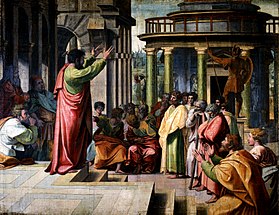
Paul in today’s First Reading has gotten one of the biggest missionary opportunities of his lifetime: preaching the Gospel in the Areopagus, the famed public square of the city of Athens where the learned gathered to hear philosophy and great ideas. Athens was at the heart of Greek culture and if Paul had success here in evangelization, it could ensure a much wider audience for the Gospel message, a much as getting “rave reviews” or “media attention” would do today in cities known to be nexus for culture such as New York, London, Berlin, etc.

Athenians prided themselves on being very rational regarding matters of religion; at one point they even dismissed their pantheon of gods whose myths were part of their upbringing. It was fashionable to be skeptical of them, yet they didn’t push it too far, which is why, as Paul notes today, they had many altars to many gods, not seeking to offend any one of them, just in case he, she, or it really was real. Rationalism and superstition sometimes go hand in hand, because the more we stoke our reason, to more something inside us gives us that nagging feeling that there’s something beyond our reasons, calling to us.

As Paul notes, they even had an altar dedicated to an unknown god, and Paul makes that an opportunity to not only introduce them to the God of which they’re ignorant, but to understand that he goes way beyond any gods they had conceived. Even as Paul, in his discourse, rationally discards the falsity of idol worship, he tries to connect the God of which he preaches to the God that rationally they were seeking. The thought of the resurrection of the dead, however, proves too irrational for most of them. As a result, we don’t have a Letter to the Athenians among Paul’s letters; the shift from rationality to testimony was too much for them. Eventually, however, Greek culture would become an incredible vehicle for transmitting the Gospel, greatly influencing all the Eastern Churches, so Paul’s work was not in vain.

There are many Areopagi in the world today, under different management, moved to new locations, where people are seeking the answers to life’s questions and don’t know that the answer is God, much less Christ. Like Paul, let’s try meeting them halfway along the rational road and bring them to meet the Risen Christ, the answer to life’s meaning that they’re seeking.

Readings: Acts 17:15, 22–18:1; Psalm 148:1–2, 11–14; John 16:12–15. See 6th Week of Easter, Wednesday.