5th Week of Easter, Thursday (2)

As we saw in yesterday‘s First Reading, the Church has convoked its first council in Jerusalem to discern whether Our Lord requires non-Jewish converts to be circumcised and follow Mosaic law in order to be saved. Discernment is about taking all the factors into consideration to see what God is asking, not to make an informed “vote”; we see that in the elements at play in today’s First Reading. After discussion and debate Peter reminds everyone that it was at the prompting of the Spirit that he approached the Gentiles at all, as we saw a few weeks ago. That was the first step toward seeing that salvation and a life of grace was open to the Gentiles. It was the grace of Christ that saved all believers, not circumcision or Jewish descent.

Then Paul and Barnabas recall all the graces and wonders they’d experienced evangelizing the Gentiles, and, surely, recalling how many times the Gentiles were more excited about welcoming the faith than the Jews were, much like today, when “cradle Catholics” at times are not as enthusiastic about the faith as those who discover the faith as adults. Lastly, James, who among those who considered themselves strictly observant Jewish Christians was well respected, and probably their leader, was able to see from Scripture that the Gentiles had a part in God’s saving plan as well.

It doesn’t always take a council to determine God’s will, but it does require meditating on what God has asked and how God has acted to try and see his will more clearly. Let’s strive to always have this spirit of discernment as well, both individually and as Church.

Readings: Acts 15:7–21; Psalm 96:1–3, 10; John 15:9–11. See also 5th Week of Easter, Thursday.
5th Week of Easter, Wednesday (2)

We are branches that depend on the main vine in order to grow and have life, as Our Lord teaches us in today’s Gospel. The First Reading teaches us how we abide in the vine, how we stay connected to the true vine, Our Lord. Another way of understanding how we abide in the vine is being in communion with God and with each other. The Church over the centuries has considered how that communion is seen under three aspects: communion in worship, communion in doctrine, and communion under the same governance.

In today’s First Reading there’s a doubt regarding how the Church should maintain her communion with the Lord and with each other. Some are saying that circumcision and following Mosaic laws, customs for the Jews, are required for salvation. The Gentiles, however, never had these customs, and Paul and Barnabas insist that they are not necessary for salvation (this topic comes up in many of Paul’s letters; Galatians, for example). Therefore a dispute has arisen in the area of worship and doctrine and the Church convokes its first council, the Council of Jerusalem, in order to resolve it and determine what Our Lord really does ask of his disciples in order to abide in him, the true vine. We’ll see the outcome in tomorrow’s reading.

Even today our bishops, in communion with the Holy Father, gather to discuss pressing issues, in synods and in meetings of Bishop’s Conferences, and watch over and foster communion so that the whole Church abides in Christ. Let’s pray for our bishops to be open to whatever the Holy Spirit instructs them for the good of the Church and of the world. That is how we’ll abide in the true vine, grow, and bear much fruit.

Readings: Acts 15:1–6; Psalm 122:1–5; John 15:1–8. See also 5th Week of Easter, Wednesday and Fifth Sunday of Easter.

5th Week of Easter, Tuesday (2)

In today’s First Reading, amidst the trials and travels of Paul’s missionary voyage, we see the Church starting to be more organized as it spreads geographically and grows numerically. Paul starts to appoint “presbyters” in each Church he founded; presbyter means “elder,” and some day this term would refer to what we now call the second degree of Holy Orders–priests–who collaborate with the first degree–bishops. In Paul’s time it gradually went from someone who worked more closely with an apostle due to knowing them as a trusted colleague to becoming more of an office, alongside other terms, such as episkopos, prophet, and teacher. No matter how it developed, presbyters participated in the ministry of the apostles for the good of the faithful and were valuable colleagues.

The apostles knew their work would have to outlive them, so in order to provide for the Church the apostolic and ecclesial ministry continued through their co-workers, like the presbyters, and even today bishops, priests, and deacons continue the work entrusted to them by the apostles and their successors. The need for priests today often outweighs the priests available to fill them. Let’s pray for vocations to the priesthood.

Readings: Acts 14:19–28; Psalm 145:10–13b, 21; John 14:27–31a. See also 5th Week of Easter, Tuesday.

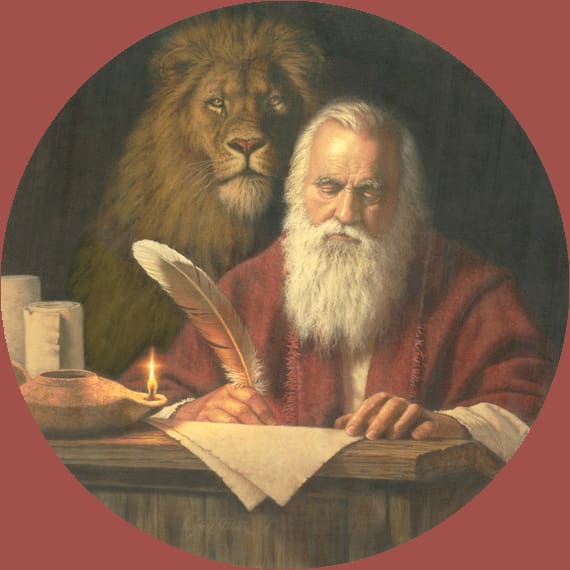
Feast of St. Mark the Evangelist (2)

Some people think discerning your vocation is like career planning, but today’s feast of Mark reminds us that praying about God’s will for your life is not exactly the same thing. It’s safe to say that Mark didn’t plan on being an evangelist. He knew many of the apostles; when Peter was miraculously freed from prison he went to the house of Mark’s mother (see Acts 12:12). Mark tried being a missionary with Paul and Barnabas, but went home before the missionary trip was over, and this upset Paul so much that when Barnabas tried bring Mark along again, he and Paul parted ways over it (see Acts 12:25, 15:37-39). It seems the missionary life wasn’t for him.

Scripture doesn’t chronicle it, but tradition holds that Mark eventually started helping Peter as a secretary (see today’s First Reading) and the accounts in Mark’s Gospel were probably the ones he heard from Peter himself. Mark probably didn’t appreciate the importance of his work in his lifetime, but we all owe him a debt for helping us remember the life of Christ through his Gospel.

What does God want you to do with your life? Don’t focus on big plans, but know he already has big plans for you. Just take one step at a time, asking Our Lord to guide you, and be open to his will.

Readings: 1 Peter 5:5b–14; Psalm 89:2–3, 6–7, 16–17; Mark 16:15–20. See also Feast of St. Mark the Evangelist.

5th Sunday of Easter, Cycle C

In today’s First Reading recalls the end of Paul’s first missionary voyage. In his lifetime he made three missionary voyages, and just like when he was knocked to the ground and blinded, he had no idea where his missionary voyages would lead him. Today he arrives back in Antioch, the Christian community who had sent him out at the Holy Spirit’s instruction, and he tells them something none of them expected: the Gentiles, the non-Jews, were welcoming the Gospel too. He encourages them to keep the faith, since, as he says “It is necessary for us to undergo many hardships to enter the kingdom of God.” Paul is saying that from experience. On the mission he just finished he had almost been stoned in one town, mistaken for the god Zeus in another, and in a third was dragged outside the city, stoned, and left for dead.

In today’s Second Reading John tries to describe what the Kingdom of God will look like one day: the Church, as splendid as a bride on her wedding day, with Christ as her spouse. In every celebration of the Eucharist we try to imitate what the Church will be like to Christ on that day: we wear nice clothes and vestments, we sing beautiful music, we use things of gold and silver and candles and nice things to celebrate Jesus coming down to be with us and come down into our hearts. Some day we will all be united, just like those people listening to St. Paul in Antioch, just as when we gather to celebrate the Eucharist, rejoicing forever with God among us and all the pain and sorrow wiped away.

St. Paul describes the path to Heaven as hardships, but Our Lord in today’s Gospel calls it the moment of his glorification. When John in his gospel talks about glorification, he is referring to Jesus being crucified. So as Judas goes out to betray Our Lord, the Lord says, “Now is the Son of Man glorified, and God is glorified in him.” He knows that the suffering and hardship that he is about to undergo will make what John sees in the Second Reading come true: all of us, united with him in joy. “The One on the throne” in the Second Reading today is Jesus Himself, and he says, “Behold, I make all things new.” Death and sickness and tiredness and effort are a part of life, but Jesus will re-new everything again: not just spruced up, new again. He is always coming into our hearts to renew us with his love, and one day, things will be as if they were brand new, forever, like a flower in the fullness of bloom, but never drying out or wilting.

Let’s love one another as he had loved us, so that in us he can continue to make all things new.

Readings: Acts 14:21–27; Psalm 145:8–13; Revelation 21:1–5a; John 13:31–33a, 34–35.