5th Week in Ordinary Time, Wednesday, Year II

In today’s Gospel, using the example of dietary laws, Our Lord is teaching us that the “Devil made me do it” as an argument has no merit. The problem of evil has plagued man and philosophy almost since Creation, and a trend has always tried to blame God or other things as the cause of sin when all man needed to do was look in the mirror. The Lord created everything good and for the good, but his creatures freely chose to do evil instead: the fallen angels, staring with the Devil, and humanity, starting with Adam and Eve. If the world is a mess it is because we, sinners, made it so.

The dietary laws in Jesus’ time believed certain foods brought ritual contamination and, therefore, defiled a man, Mark makes a point of saying in his account that Jesus is teaching that there are no ritually impure foods. It’s a teaching that even the first disciples would struggle with as they realized that Christianity was meant to go beyond the Jewish world and culture. The Original Sin of Adam and Eve robbed us of something we, their descendants, couldn’t do without, and it is only thanks to the Redemption that their sin didn’t condemn us all to spiritual death. However, Adam and Eve aren’t to blame for all of it: we too have sinned and continue to sin.

This sobering reality is not meant to discourage us; rather, it makes us realize that not only do we need Savior, but have one: Our Lord. The Sacrament of Reconciliation is also called Confession. Let’s come clean and confess what we’ve done so that Our Lord can heal and liberate us from the sin plaguing the world since the Fall.

Readings: 1 Kings 10:1–10; Psalm 37:5–6, 30–31, 39–40; Mark 7:14–23.

5th Sunday in Ordinary Time, Cycle B

Today’s readings remind us that if the Gospel is really good news to us we should share it.

In today’s First Reading Job is in desperate need for some good news after being so afflicted. He’s lost property, family, and health. Life has become pure drudgery for him with the rest or reward that should follow still far from sight. How many of us mid-week have a similar attitude? It seems the next break, the next paycheck is too long in coming in the face of the daily grind. Yet we have to admit that when that lunch break or paycheck comes it doesn’t satisfy us for very long, and we go right back to the drudgery. In a hopeless life there’s little good news to share. Yet even Job knows his redeemer lives. Life is not entirely hopeless.

In today’s Second Reading Paul reminds us that the Gospel is good news that is meant to be shared. He lived in a world of Job’s, and so do we. People need something to lift them up from their drudgery. Spreading the good news for Paul is not just something he wants to do, but something he felt obliged to do. There’s no catch. He’s not trying to sell anything. He’ll do whatever it takes to make sure the Gospel is received as good news. Paul’s example teaches us that if we don’t share the good news it could be because for us it is not good news. If it’s not good news for us, then what is it?

In today’s Gospel we see the first moments of Our Lord’s earthly ministry continuing to take shape. After an impressive demonstration of authority and power in the synagogue, he comes to Simon Peter’s house and heals his mother-in-law. Soon people are coming from all over the village, bringing the sick and those afflicted by demons so that Our Lord can heal them and liberate them from evil.Despite this success, he knows he can’t just stay in one village, but bring his teaching and power everywhere.

Good News spreads fast. Today we live in a society where the Good News has been spread far and wide, yet people don’t come to Our Lord for healing and liberation from the evil afflicting their lives. Why? We have a duty to spread the Good News, but that’s not just quoting the bible chapter and verse, but by giving testimony to the impact Our Lord has had on our own lives. Those crowds in the Gospel today would not have heard anything if Our Lord had not taught, healed, or exorcised someone they knew.

It’s very easy to gossip, and gossip these days is usually corrosive, not constructive. Sometimes people giving up cigarettes take up sucking on a lollipop instead. Everyone knows gossip is wrong, but quitting cold turkey can be especially hard. Make a resolution to swap out that gossip with good news instead. Spread some hope and encouragement instead of negativity and cynicism.

Readings: Job 7:1–4, 6–7; Psalm 147:1–6; 1 Corinthians 9:16–19, 22–23; Mark 1:29–39.

4th Week in Ordinary Time, Tuesday, Year II

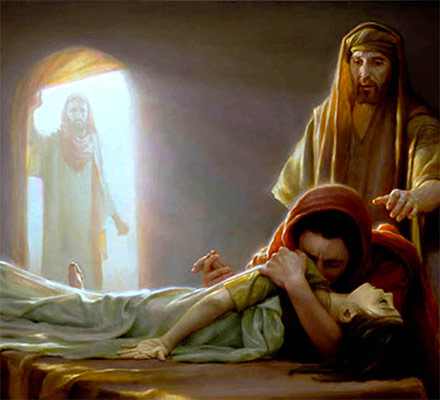
In today’s Gospel Jairus and the woman suffering from a hemorrhage teach us that if we take a risk and believe in Christ, things will exceed our expectations. Jairus risked his reputation as a synagogue official, trusting in a Rabbi with miraculous powers with the hope of healing his dying daughter. The ailing woman risked being the fool when she believed she could touch Our Lord’s cloak and receive healing unseen. Her healing and encounter with Our Lord were just in time to give Jairus the encouragement he needed when news reached him of his daughter’s death. Jairus still believed in Our Lord, even when he realized he was now asking for something much greater.

The mourners for the little girl were scornful and incredulous when Our Lord said the girl was only sleeping. As Christians we know Our Lord was saying something much deeper: death is simply a “falling asleep,” as Paul would later say in his letters, awaiting the Resurrection from the dead. Jairus for his faith didn’t have to wait until the life of the world to come to be with his daughter again.

The hemmorraghic woman didn’t expect she’d have to explain herself in front of the crowds. Jairus didn’t expect that he’d be asking for his girl to return to life. They took a risk and had faith in Our Lord, and he blessed them beyond their expectations. Let’s also take a risk of faith. We won’t be disappointed.

Readings: 2 Samuel 18:9–10, 14b, 24–25a, 30–19:3; Psalm 86:1–6; Mark 5:21–43. See also 14th Week in Ordinary Time, Monday, and 13th Sunday in Ordinary Time, Cycle B.

4th Sunday in Ordinary Time, Cycle B

In the First Reading, Moses promises the Israelites that someone like him will come. Moses after leading the Israelites out of Egypt and in the desert for 40 years is giving his last will and testament. He knows his time on earth is about to end. The one he promises will come is not just some simple political leader: Joshua is already taking care of that, and many leaders of Israel after him. The one he promises will come is an answer to their prayers on Mt. Horeb. They asked at that mountain to deal with God face to face, without the need for Moses or anyone else, and the experience of the enormity of God and their own inability to respond to him filled them with so much fear at that mountain that they asked that in the future they always had a go-between, a mediator between them and God.

The Lord promises through Moses that a prophet was to come who would speak to Israel on behalf of the Lord, and in the Lord’s name, a prophet from among their own kin. And he reminds them that prophets who don’t come in the Lord’s name or speak his words will die. This is part of something else Moses says in the book of Deuteronomy that we didn’t hear today: Moses offers two choices on behalf of the Lord: a blessing—life by living in the Lord’s ways, or a curse—death for turning to other ways. Each prophet of the Lord in the centuries to come after Moses promised the coming of this big prophet, all the way to John the Baptist. In the Gospel of John, when John the Baptist begins baptizing in the Jordan, the Pharisees, who are now the leaders of the Jews, come and ask him, “are you the Prophet?”: they’re referring to this promise of a prophet that Moses made. And John replies someone greater is coming, and to get ready.

When that prophet comes, it is Jesus of Nazareth, Our Lord, as the Jews find out today in the Gospel of Mark. They’ve waited hundreds of years, prophet after prophet promising them someone greater was to come, and then waiting as scribes and learned men kept trying to help them understand what God was asking them to do in their lives by reading and debating over scripture and the Law that they had received from Moses. However, all these scribes and learned men who interpreted the scripture and the Law had to play it safe: they knew they weren’t prophets of the Lord, and they knew that if they spoke something that came only from them, and not from God, it would mean death, not just for them, but for many.

In this backdrop, Jesus comes into the synagogue and speaks the word of Life, because he is the Word of the life. And the Jews are astonished, because he doesn’t play it safe, like the scribes: he knows he brings the truth, he knows he brings eternal life, so he tells it like it is. The one Moses promised them has come. Even the demons know, and they know that their dominion over the world is about to be seriously undermined, and they start howling, like that man in the synagogue with an unclean spirit. So if the conviction of His words alone was not enough, Jesus gives the Jews a sign: he casts the demon out of the possessed man with a few words, and news starts to spread around Galilee.

These words and events don’t stay confined to their moment in history. Through them God is trying to say something to us right here, right now, through Jesus’ words and actions. Jesus has come into the synagogue of our hearts and lives, and he speaks to us with authority and with power. Even the unclean things swirling around in us, keeping us from heeding His word, are telling us that Jesus is the Holy One of God. The unclean spirit in the synagogue didn’t say, “Oh no, this scribe is intelligent, he’s too eloquent, he must have a degree from the Biblicum or Harvard, he’s too smart for us”; the unclean spirit said, you are the “Holy One of God.” No force of evil can withstand holiness, because holiness is a gift of God, and it comes to us through and thanks to His Son.

Our Lord wants to bring us holiness. In every Baptism he casts out unclean spirits, in every Eucharist he fortifies hearts against evil, in every Reconciliation he reunites sinful man to his Creator, in every Confirmation he strengthens apostles for combat against the forces of evil in the world, and with every Christian Marriage of conferral of Holy Orders, He helps Christians respond to their calling from God and receive help to answer that call through living a holy life. It’s not something automatic; we have to want it, and it’s something we have to fight for every day, in season and out of season, striving to accept these gifts of holiness so that they bear fruit in our life through prayer, sacrifice, and a constant determination for the good of all. It’s not something we accomplish alone; God has sent His Son to help us every step of the way.

The words of St. Paul in the Second Reading today help us all to take stock of how we are responding to Jesus’ invitation to help us. St. Paul presents two categories of Christian, and what they should be focusing their attention on: the unmarried should be focused on the things of the Lord, and how to please Him; the married should focus on the things of the world and how to please their spouse. This advice helps each of us to measure whether we’ve invited Jesus into our hearts and listened to his word.

When St. Paul speaks these words, we examine ourselves. For those who are single, am I anxious about the Lord’s things and pleasing him? For those who are married, am I anxious about the world’s things, and pleasing my spouse? The one thing we shouldn’t be anxious about is ourselves. Our Lord will take care of us, if we let him in our hearts and heed his word, just as he promised.

Let’s answer the words of the responsorial psalm today, by promising not to harden our hearts to the Lord and to the needs of others. Let’s examine ourselves, in the synagogue of our hearts, and ask Our Lord to show us just one thing in ourselves or in the world that He wants us to change by working with Him and His grace. Let’s ask Our Lord for the gift of holiness, which is the gift of his life and love, and to be an instrument of his holiness for others as well.

Readings: Deuteronomy 18:15–20; Psalm 95:1–2, 6–9; 1 Corinthians 7:32–35; Mark 1:21–28.


3rd Week in Ordinary Time, Monday, Year II

Today’s Gospel has a strong admonition regarding blasphemy against the Holy Spirit. An unforgivable sin should give pause to anyone, but in this case the Evangelist explains what the Lord is condemning: calling the Holy Spirit an “unclean spirit.” Jesus works his miracles in the power of the Holy Spirit, but the scribes claim the demon Beelzebub is powering his works. A clearer blasphemy is not possible. Our Lord refutes their absurd logic: why would demons cast out demons? What would it benefit them? The scribes are so paranoid about Our Lord that their theories are increasingly absurd.

Let’s pray today that everyone receive the gift of faith to see the Holy Spirit at work and acknowledge it.

Readings: 2 Samuel 5:1–7, 10; Psalm 89:20–22, 25–26; Mark 3:22–30. See also 27th Week in Ordinary Time, Friday.