Easter Sunday, Mass During the Day (3)

Today we consider the mystery at the heart of the Christian faith. It is simple, but extraordinary and powerful. It was so mind-blowing that even the disciples and the apostles Jesus told it would happen didn’t believe it until they saw him. It shattered all their concepts of life. In the whole history of humanity death was the greatest fear, the curse to wish or inflict on your worst enemies. It was conquered. “Christ is Risen” says it all. We can no longer live the same way now that death has been defeated in Christ.

In today’s First Reading St. Peter reminds us that the Risen Christ only revealed himself to those who believed in him. Only those who believed in him were then blessed by meeting and eating and drinking with the Risen Lord. He reminds us that “everyone who believes in him will receive forgiveness of sins through his name”: on the day of our Baptism we had an encounter with the Risen Lord that transformed us into children pleasing to Our Heavenly Father, and he continues to reveal himself to those who believe in him. An encounter with the Risen Christ in faith is always a salvific and transforming experience.

In today’s Second Reading St. Paul reminds us that an outlook of faith keeps our eyes fixed on the things of above. When we gaze above in faith we know the Risen Christ stands at the right hand of His Father and intercedes for us. If we don’t see him it is because our faith is not strong enough and we need to beg for more. Pope Francis describes a certain class of Christians in Evangelii Gaudium who seem to live a permanent Lent: they have not had an experience of the Lord and his love, and, therefore, the Gospel brings them no joy. The Resurrection banishes vanity from our lives and changes our perspective.

In today’s Gospel we see that the Resurrection didn’t sink in for the disciples until they witnessed the results themselves. It leaves us in hopeful suspense because death no longer had the last word. The disciples had all the facts. Christ could raise the dead. Martha saw his brother Lazarus raised after three days in the tomb. The mourners of the dead little girl’s daughter mocked Jesus when he said she was sleeping, and then he “woke” her up. Even Mary thought today that the body had been stolen. The disciples walking to Emmaus had all the facts. After the Transfiguration he told Peter not to tell anyone until he was raised from the dead, and kept repeating that he would be raised from the dead on the third day. The disciples were clueless. We can’t blame them. Even today there are a lot of disciples of Christ who are clueless. All the facts are at hand, but they lack faith and so they live as if eternal life is a faery tale.

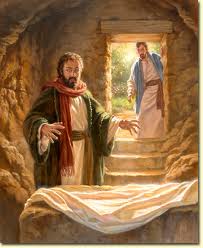
We have many more signs that they did: the Church has testified to the Resurrection for over two thousand years, and many of her children have gone to the grave believing that someday they would rise, just as Our Lord did. Like John in today’s Gospel let’s look at the signs of Jesus’ resurrection–an empty tomb, a suspiciously well-folded head wrapping–and simply believe.

Readings: Acts 10:34a, 37–43; Psalm 118:24; Psalm 118:1–2, 16–17, 22–23; Colossians 3:1–4; 1 Corinthians 5:7b–8a; John 20:1–9.  See also Easter Sunday, Mass During the Day and Easter Sunday, Mass During the Day (2).
Easter Vigil, Cycle A

This evening we begin the Easter season by celebrating the gift of new life in Christ. Our Lord lives anew, and, like the candles lit one by one from the blessed Paschal flame in today’s liturgy, that new life reaches each of us, one by one. The candles we bear in this ceremony remind us of that day when someone handed a lit candle to our godparent and said, on our behalf, “receive the light of Christ.” This evening throughout the world catechumens receive the sacraments of Christian Initiation–Baptism, the Eucharist, and Confirmation–and receive new life in Christ as they come fully into the Church.

This evening is a reminder and a renewal of our new life in Christ as well. Whether our celebration of the Easter Vigil includes catechumens or not, we renew our baptismal promises and receive a blessing with holy water to remind us of the blessing of new life in Christ that came to us through the waters of Baptism. These promises remind us how we are to best live the new life Our Lord has given us: we renounce Satan, all his works, and all his empty show; and we renew the basics of our faith that we recall every time we pray the Creed.

Let’s pray for those coming fully into Church communion this evening, and pray that we be renewed in our desire to live well the new life in Christ that we have received. Christ has risen.

Readings: Matthew 28:1–10. See also Easter Vigil, Cycle C and Easter Vigil.

Good Friday, Commemoration of the Lord’s Passion (3)

As we contemplate Our Lord crucified today, we behold a tragedy, the tragedy of an innocent man publicly executed. Jesus’ only “crime” was to identify himself as the Messiah, and that’s who he was; he did so to the Sanhedrin, so they decided to have him killed, and he did so to Pilate, who sentenced him to death.

His response leaves us as dumbstruck and confounded as the kings of the world mentioned in today’s First Reading. Isaiah’s description of the Suffering Servant is a description of Christ raised on the Cross: “…my servant shall prosper, he shall be raised high and greatly exalted…so marred was his look beyond human semblance…so shall he startle many nations, because of him kings shall stand speechless…” He takes the punishments we deserve upon himself: “he was pierced for our offenses, crushed for our sins” He doesn’t just say, “never mind, I forgive you”; he hands himself over to evil men to be tortured and executed. He teaches us how horrible the effects of sin are, not just to us, but to him, and that our sins have consequences. Yet Isaiah also reminds us that by his wounds we are healed. His suffering is not in vain. He has won pardon for our sins.

Today’s Second Reading reminds us that through this suffering Christ made salvation possible for us. Our Lord assumed nature to redeem us, but also to experience everything we experience as human beings except for sin. When tragedy strikes us we can rail against God, but Christ on the Cross reminds us that he is not ignorant to our sufferings because he himself has suffered. We know everything he has endured for us, therefore we know that when we’re truly sorry for what we’ve done he’ll grant us his mercy. We just have to ask. As Pope Francis reminds us, God doesn’t tire of forgiving us; we get tired of asking for his forgiveness.

As today’s Gospel reminds us, Jesus had his ID card hanging right over his head: “Jesus the Nazorean, the King of the Jews.” It was meant as mockery, but it was the truth, the truth to which he had testified all along. If the execution of a guilty man doesn’t give us remorse (and it should, since it presents a failure of all society, not just the criminal), the execution of an innocent man should. This tragedy is even more profound when we gaze upon the Crucified One and remember that we should have been on that Cross instead of him.

An innocent man is dying, brutalized on the Cross, for us. Adam and Eve’s Fall and our sins incurred the death penalty. After all God had given us and done for us, we’ve repaid him by turning our backs on him, again and again. Even in his last words Jesus asks the Father to forgive us for our ignorance.

Today is a day not to dwell on the tragedy we inflicted on the good God who came to save us, but the love with which he did. Let’s die to sin and turn back to God and back to love.

Readings: Isaiah 52:13–53:12; Psalm 31:2, 6, 12–13, 15–17, 25; Hebrews 4:14–16, 5:7–9; John 18:1–19:42. See also Good Friday, Commemoration of the Lord’s Passion, and Good Friday, Commemoration of the Lord’s Passion (2).


Holy Thursday, Evening Mass of the Lord’s Supper (2)

With this celebration, the Evening Mass of the Lord’s Supper, we inaugurate the Sacred Paschal Triduum. We inaugurate three days of life, suffering, passion, death, and Resurrection. We return to the upper room with Our Lord and his closest disciples, and we remember three inestimably valuable gifts that Our Lord gives us on this night: the Eucharist, the priesthood, and the commandment of love. Each one shows how much he loves us and should instill in us the desire to love him and others in kind.

In today’s First Reading Moses describes to the Israelites, still enslaved in Egypt, the importance of the Passover not only for that night, but for all nights to come. In the Passover the Paschal lamb was sacrificed and its blood spread over the doorpost and lintels to keep them from death. In the Last Supper the Lord states his intent to become the true Paschal lamb. He will be sacrificed on Good Friday and through his blood we will be saved from the spiritual death that sin inflicts. In instituting the Eucharist he asks us to perpetually commemorate his sacrifice: “do this in memory of me.”

The Eucharist, however, is something much more: it, simply put, is him. In every celebration of the Eucharist we re-offer in an unbloody manner what he once offered on the Cross: himself. Through the Eucharist he remains with us always and always offers himself for us, because he loves us. The greatest sign of love and friendship is when someone is always there for you. Our Lord is always there for us, through the Eucharist.

In today’s Second Reading Paul recalls Christ’s words to celebrate the Eucharist in “remembrance” of him, and that reminds us of who Christ gave us to continue celebrating the Eucharist in his memory: our bishops and priests. At the Last Supper Our Lord entrusted the apostles with the task of celebrating the Eucharist in his memory, and in this very action he consecrated them priests. They weren’t priests on their own account. Christ, as the Letter to the Hebrews reminds us, is the High Priest. The offering they raise up to God the Father is Christ himself. All other bishops and priests participate in his priesthood, and through the sacrament of Holy Orders they’re changed, sealed in such a way that they can render Our Lord present in the celebration of all the sacraments, especially the Eucharist.

Paul says simply that he is handing on what he received from the Lord. That’s what all bishops and priests strive to do. Christ handed on something to the apostles, who handed it on to their successors. The bishops are the apostles’ successors, and they’re aided in continuing the apostolic mission by priests.

This morning (or earlier in Holy Week, depending on the diocese) the bishop(s) and priests of the diocese gathered at the cathedral in order to consecrate new sacred oils for the year to come, but also to renew their priestly promises. Our priests renewed their commitment to “be more united with the Lord Jesus and more closely conformed to him,” “to be faithful stewards of the mysteries of God,” and to be “moved only by zeal for souls.” This evening we too pray in gratitude for our bishops and priests so that they receive the grace and strength to remain true to these promises. Our Lord has chosen to bring his love to us through them.

In today’s Gospel Our Lord gives us an applied lesson in the last of three gifts that he gave us on the night of the Last Supper: the commandment to love. The washing of guests’ feet before a Passover meal was common Jewish hospitality at the time, but it was done by a servant, not by the host or head of the family. Our Lord is teaching a lesson he expects his disciples to imitate, which is why he is so hard on Peter when he balks at having his feet washed by Our Lord.

Our Lord’s response is interesting: “Unless I wash you, you will have no inheritance with me.” He is trying to give Peter something. Our Lord is not only trying do his closest disciples a service; he is teaching them to serve one another as well. If Peter had refused, would he ever have done it either? Perhaps an inheritance would have been lost, the inheritance of loving one another, in this case, through service, just as Our Lord did. In John’s account of the Last Supper this is just the first gesture showing the importance in Jesus’ mind of his commandment to love.

Readings: Exodus 12:1–8, 11–14; 1 Corinthians 10:16; Psalm 116:12–13, 15–16c, 17–18; 1 Corinthians 11:23–26; John 13:1–15. See also Holy Thursday, Evening Mass of the Lord’s Supper.

Image result for gibson the last supper

Palm Sunday of the Lord’s Passion, Cycle A

With this liturgy we stand at the threshold of Holy Week, the week in which we commemorate the profoundest mysteries of life and death, of God and man, of love and sin. We’ve prepared for forty days to step into Holy Week and remind ourselves that by doing so we step into a new life won for us by Christ at a high cost. We mustn’t take this step lightly.

We have two Gospels today, one before the procession, and one narrating the Passion. In the first Gospel Matthew reminds us that Our Lord took the first step humbly, just as we should do. He didn’t commandeer the ass on which he rode into Jerusalem; he borrowed it. His disciples made a great commotion with a lot of fanfare, but they also showed at the same time that they still didn’t completely get it. “Hosanna to the Son of David”: He was the Messiah and they expected him to clean house, to become a great political and military leader with miracles and fulminations in his wake. “This is Jesus the prophet”: He was the miracle-machine.

We know he was more than a prophet or a political leader with divine aid, and we also know his mission was conquest by Cross. Within a day their convictions were shaken to the core. Holy Week is a time for considering our convictions in the light of Christ’s Passion, Death, and Resurrection. They may need some shaking up too.

In today’s First Reading the prophet Isaiah, describing the Suffering Servant, reminds us that Our Lord knew he was in for suffering, but if it was in the Lord’s service it was worth it. We call today “Passion” Sunday not because of Our Lord’s passionate love for us, even though he does love us passionately in the true sense of the term. Passion comes from the Latin word passio, which means suffering, undergoing something.

Our Lord enters Jerusalem knowing a new level of suffering is at hand, but he does not hesitate, because the stakes are our salvation. If we think life is hard, imagine how hard it was to set Heaven aside even a moment and become man as Jesus did. Yet he not only became man, he became a servant of all, and servant who suffered for all.

In today’s Second Reading Paul reminds us that Christ had no need or desire for more glory, yet he did something for us and for his Father worthy of even greater glory.His Incarnation was lowly and poor. He didn’t take half measures in his mission by becoming a child of royalty living in palaces. God became a slave. For us. He taught us humility and obedience so that we would follow his example.

In today’s Passion narrative we walk with him in his last hours of angst, betrayal, solitude, and pain when what he sought from us (and for us) was peace, loyalty, communion, and joy. There’s not much more to say: Our Lord’s actions on our behalf say it all.

The Passion narrative is long, too long to plumb all its meaning by just hearing it once a year (or even twice). This year’s narrative is Matthew, why not take the text this week and meditate on a little of it each day leading up to Good Friday? If you participate in the Commemoration of the Lord’s Passion on Good Friday it will help you connect much more deeply to the mysteries we are celebrating.

Readings: Matthew 21:1–11; Isaiah 50:4–7; Psalm 22:8–9, 17–20, 23–24; Philippians 2:6–11; Matthew 26:14–27:66.