29th Week in Ordinary Time, Saturday, Year II

In today’s First Reading Paul describes the Church as the Body of Christ. In his time Greco-Roman culture explained how all the members of society fit together using the image of a body, and Paul might have received some inspiration from this philosophy, but he goes beyond it to emphasize that the Church is the Body of Christ because the Church has Christ as her Head, giving her life and direction. What later reflection would describe as the Body of Christ is not a moral body, people just united by some external purpose, or a physical body, where the parts lose their individuality in the whole. Rather, it is a Mystical Body that depends on her Head, Christ, in order to have direction and life, made possible by the Holy Spirit, who unites her spiritually.

We don’t stop being individuals by being members of the Body of Christ, but we do receive life from it and must perform our function for its life and growth as well. Paul describes various figures in the early Church comprising the Body and helping to edify it: Apostles, prophets, teachers, and so on. Each has a role, like a part of a body, but not all have the same role. The important thing is that the parts work together for the good of the Body, and remain united to their Head, otherwise they’ll not get very far.

Paul describes the signs of the Body working well: unity, charity, and maturity. Let’s ask Our Lord to help us edify his Mystical Body in whatever role to which he has called us.

Readings: Ephesians 4:7–16; Psalm 122:1–5; Luke 13:1–9. See also 29th Week in Ordinary Time, Saturday.
6a0133f3b4cb35970b0153914e2b6a970b-800wi

29th Week in Ordinary Time, Friday, Year II

In today’s First Reading Paul encourages the Ephesians to practice the virtues that will ensure their unity in serving the Lord, in the faith, and in baptism: humility, gentleness, patience, and love. Christians have not always lived these virtues and it has not only undermined our unity, but also undermined our mission. We still all share one Lord and one baptism: every Christian through Baptism is incorporated into the Mystical Body of Christ, but through historical disagreements in East and West we no longer agree on the fullness of faith and how it should be lived and put into practice. We don’t all share the same articles of faith, worship, or governance; those three elements all stem from our faith in how Our Lord has handed on the faith to the Apostles and to us through the centuries.

Paul’s exhortation today is a call to duty to all Christians today. We must be one. To strengthen and full restore Christian unity we must come together in humility, gentleness, patience, and love, just as Paul teaches us, and we will overcome our differences and disagreements because the mission demands it and it is not just Paul’s desire, but Our Lord’s as well. Let’s pray and work that one day we’ll once again profess one faith, celebrated on Eucharist, and be united under the same pastoral guidance.

Ecumenism involves discussion and frank dialogue, but it starts with virtue. Ask Our Lord to help you practice some “virtuous” ecumenism today. Every bit helps rebuild unity.

Readings: Ephesians 4:1–6; Psalm 24:1–4b, 5–6; Luke 12:54–59. See also 29th Week in Ordinary Time, Friday.

29th Week in Ordinary Time, Thursday, Year II

Paul in today’s First Reading kneels before God the Father in order to thank him not only for the communion of saints, a communion shared by believers on Heaven and on Earth, but a communion with God the Father, Son, and Holy Spirit that makes every participant a member of the family of God. Our fellow believers are our brothers and sisters, and we have them here and in eternity, cheering us on, encouraging us and interceding for us, filled with the hope that some day, by the grace of God, we’ll all be together in Heaven.

The Holy Trinity wishes to pour life and love into our hearts, and this is the fire that Our Lord wants to kindle in today’s Gospel. If divisions occur, even among those we love, it is because on one side or the other the love is not strong enough for both sides to “catch fire.” We have to be on fire for love of Our Lord and hope that our blood relations also “catch fire” and become part of the family of faith as well. Our Lord died on the cross to make that flame of love burn bright, so we should not be afraid of laying down our lives, spiritually or otherwise, in order to help others catch fire.

As believers the way we should treat our family and others is simple: with the love of a family. Let’s ask the Holy Spirit to keep the fire of that love kindled in us and to prepare the hearts of others to catch fire as well.

Readings: Ephesians 3:14–21; Psalm 33:1–2, 4–5, 11–12, 18–19; Luke 12:49–53. See also 20th Week in Ordinary Time, Sunday, Cycle C15th Week in Ordinary Time, Monday, Year II29th Week in Ordinary Time, Thursday, and 15th Week in Ordinary Time, Monday.

29th Week in Ordinary Time, Wednesday, Year II

At the Basilica of St. Paul’s Outside the Walls in Rome there is a statue of St. Paul in the courtyard with the inscription in Latin that, translated, means “teacher to the nations.” Paul in today’s First Reading is marveling at how much bigger his mission is than he would have imagined when he was a zealous Jew persecuting “heretical” Christians who’d corrupted the Jewish faith. It’s ironic that after being so dedicated to the Jewish faith and consumed with zeal to punish and imprison Jewish “heretics” the Lord would reveal to him that his mission was among the non-Jewish nations and he would spend much of his mission refuting those who tried to Judaize Christianity.

Throughout salvation history the Lord revealed his saving plan gradually. In one moment it seemed the people of Israel were to be the only ones blessed and chosen by God, but even in their time the Lord hinted at their conversion being part of something much bigger. In the end the people of Israel were just one stage of the preparation to save all the nations, and the apostles, especially Paul, saw that the truth of the Gospel went beyond the Jews to the whole world.

Paul was one of the faithful servants to which Our Lord alludes in today’s Gospel. He had received the grace of a special and important mission in the early Church and beyond. Yet he didn’t see it as a burden; he saw it as a gift. Ask Our Lord today to help you see what gift he wants you to receive for the benefit of others. There are still many people who’d be shocked to hear that the Lord wants to bless and choose them too. Be the bearer of that good news in their lives.

Readings: Ephesians 3:2–12; Isaiah 12:2–3; Luke 12:39–48. See also 19th Week in Ordinary Time, Sunday, Cycle C29th Week in Ordinary Time, Wednesday, and 21st Week in Ordinary Time, Thursday.

St. Luke, Evangelist

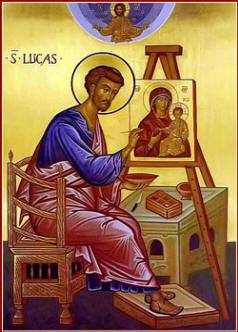
In Luke’s Gospel, alongside the account of the Twelve being sent out, he speaks of Seventy-Two being sent out by Our Lord with a very similar mandate. Luke probably identified with the Seventy-Two; the needs of the Gospel were expanding and more help was needed. As today’s First Reading reminds us, Luke accompanied the apostle Paul in some of his missionary work. In the Acts of the Apostles, written by St. Luke, the narrative switches from speaking about Paul to speaking about where “we” were and what “we” did. Luke never imagined the special collaboration he would have with the Apostles: he was not just a co-worker, he was an evangelist.

He was probably a second or third generation Christian, so while he lived at the same time as the Apostles, he also knew the Church would continue after their passing. In addition to recalling the life of Our Lord in his Gospel he left us the Acts of the Apostles to see how the Apostles carried on Our Lord’s mission after his Ascension, spurred on by the Holy Spirit. He was well aware that soon his generation would carry on the mission, just as the Apostles had done.

Luke reminds us on his feast day that just because we’ve come after the first generations of Christians doesn’t mean we should be less engaged in continuing Our Lord’s mission. Luke was not an optional evangelist, and he even went beyond the evangelist mandate by giving us the Acts of the Apostles. Let’s ask him to help us see how we can bring the Church’s work of evangelization forward.

Readings: 2 Timothy 4:10–17b; Psalm 145:10–13, 17–18; Luke 10:1–9.