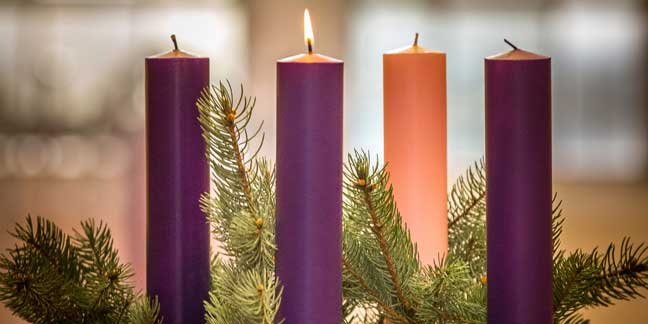
2nd Sunday of Advent, Cycle C (2)

Advent is a time of penance and conversion, but is also characterized by Messianic hope: our penance and conversion reflect a good work that is already underway, a good work that is about to experience a boost and a means to bear fruit in the birth of Our Lord at Christmas. As St. Paul describes it in today’s Second Reading: “the one who began a good work in you will continue to complete it until the day of Christ Jesus.” Our Lord enables us to definitively leave our sinful past and ways behind, and that is a cause for joyful hope.

In today’s First Reading Baruch reminds Israel that the Lord is coming to help smooth the way so that they can return to Jerusalem in triumph. The Lord had taken Israel from being a nomadic people wandering in the desert (Abraham) to the Chosen People in the Promised Land, a nation. Their sins drove them into exile and scattered them again, and refugees don’t have the luxury of dressing in their “Sunday best.” Baruch encourages Israel to foresee the moment when they’ll cast aside the rags of their affliction and dress in their “Sunday best” because the Lord is bringing them back to Jerusalem.

The peaks and valleys that make any journey more difficult will be leveled to pave the way for a people that were once exiled and defeated, but now are victorious thanks to the Lord. Even as they were exiled the Lord promised through his prophets to bring them out of the desert and back into their Land again. Salvation was underway even then. Advent reminds us that salvation is underway and has been from all eternity, culminating in the Incarnation and Birth of Our Lord Jesus Christ.

In today’s Second Reading St. Paul reminds us that the good work in us, a work we are trying to capitalize on in Advent, wasn’t started by us, but it can be finished by us, for good or for ill. The Lord from all eternity wanted us to be gathered around his Son before him in Heaven. Adam, Eve, then we blew it. Our Lord came to deliver us from our predicament, but the Holy Spirit was working in our hearts long before that, nudging us toward contrition and conversion for our sins, trying to get us disposed so that the good work could get back on track (in Christ) after we’d derailed it (through our sins).

We received the grace of redemption at Baptism, Paul encourages us today to trust in Our Lord and trust that the good work of redemption will reach its completion thanks to him. Our redemption is underway. It’s not finished yet. Paul also reminds us that the work of redemption is a work of God’s love: it wants to spark something in us, a love that burns all secondary and disordered loves away. Through that good work the Lord’s love reaches out to us, and, straining toward his, our love reaches out to him. His love reached out to us first, and it continued to reach out to us after we’d sinned and continues to reach out to us whenever we reject it by sinning.

In today’s Gospel John the Baptist is mobilized to get the word out that the Lord is coming to lead anyone to salvation who wants it. Today’s Gospel said the “word of God” came to him, something prophetic. God addresses his word to his prophet to set something good into motion. At that moment, just as in Advent, the good work was simply an announcement: the Lord is coming, get ready. The way to get ready was to receive John’s baptism (a gesture of repentance, not the Baptism we’ve received that was instituted by Christ) and seek forgiveness for our sins. We could never extricate ourselves from the consequences of our sins alone: John is announcing that the Lord will pave the way for our forgiveness and our conversion. The Lord is coming within reach. We need to start reaching out to him during Advent.

The holiday season is a special time for reaching out in a special way to those in need, whether spiritually or materially. Outreach literally means “reaching out.” Helping the poor is always important. Reaching out to reconcile with those with whom we’re estranged is also a beautiful way to welcome Our Lord at Christmas. Reaching out to those who are lonely, those whose family is far away, or those coping with loss. Reaching out to that irascible person who is difficult to get along with, getting under that crusty armor to discover who they truly are and show that you “get it.” You may not need to go very far. Some of these people you might even find in the privacy of your own home or family.

Readings: Baruch 5:1–9; Psalm 126:1–6; Philippians 1:4–6, 8–11; Gospel Luke 3:1–6. See also 2nd Sunday of Advent, Cycle C.

Advent Week 2

1st Sunday of Advent, Cycle C (2)

A new liturgical year begins today, and we inaugurate it with the season of Advent, a time of joyful expectation and spiritual conversion to prepare for the birth of Our Lord at Christmas. Today’s readings remind us that Advent is a time for preparing our hearts for the coming of Our Savior.

In today’s First Reading the Lord announces through Jeremiah that the promises made throughout salvation history are about to be fulfilled, masterfully evoking the sense of anticipation we’re called to live in Advent. Jesus is that shoot that springs up from the line of King David, destined to be a just king who brings safety, security, and justice: in a word, the long-awaited Messiah. Humanity will no longer be left alone in the dark of sin and menaced by the shadow of death. At the time of Jesus’ birth, the people of Israel, who’d received so many promises, including this one, were scattered throughout the known world and under the dominion of a foreign power. Hope was the only thing they had left. Advent is a time when we start to see the light at the end of tunnel: the birth of Our Savior.

In today’s Second Reading St. Paul reminds us of the most important thing brought by the Messiah: the love of God in Person. Paul reminds us that we need to get ready for Our Lord’s arrival, which is the purpose of Advent, and how. The Lord wants to increase the love we have in our hearts, not only for him, but for each other. It takes strength of heart to welcome Our Lord as he deserves at Christmas. Advent is a time of conversion: a time for turning out hearts back to him if they’ve strayed. It’s also a time for turning out hearts back to each other. It’s no coincidence that during this season we turn back to our families and think more about those in need. Our Lord came for both those reasons: we need salvation and help coming in from the cold solitude of sin that separates us from him and from each other.

In today’s Gospel Our Lord teaches us, describing his Second Coming, that the heart cannot rely on feelings alone, which change like the wind, if it wants to endure trials. The heart must rely on something deeper. The Lord foretells the calamities that will fall, but he tells us to be steadfast in those moments, because he as Our Redeemer is coming. Everyone endures trials in life, and, strangely, during Advent the preparations for Christmas are a trial for some: shopping, preparing for family visits, juggling work, study, and family time, etc. The “trials” of Advent are actually opportunities. We can make them a Christmas gift for Our Lord by putting love into everything we do during Advent: giving out of love, serving visiting family and friends because we love them, not just out of obligation. It’s not that we don’t love at all in doing those things; rather, it’s an opportunity to increase our love as St. Paul suggests in today’s Second Reading. Perseverance’s worth is measured by what it endures, and whether Advent is a time of joyful expectation for us or something we “survive” Our Lord will show us how to live it in a spiritually fruitful way.

There are two Advent traditions that are great for fostering joyful expectation: lighting a candle of the Advent wreath each Sunday or using a special Advent calendar. Don’t just foster that expectation; put it into action. Whether you celebrate every Sunday or every day, put a little spiritual gift for Our Lord (an extra prayer, an act of charity, a sacrifice) by the wreath or calendar every time you recall Christmas getting closer. Our holiness is best gift to offer Our Lord at Christmas.

Readings: Jeremiah 33:14–16; Psalm 25:4–5, 8–10, 14; 1 Thessalonians 3:12–4:2; Luke 21:25–28, 34–36. See also 1st Sunday of Advent, Cycle C, 34th Week in Ordinary Time, Thursday and 34th Week in Ordinary Time, Saturday.

Image result for advent wreath week 1

Solemnity of Christ the King, Cycle B

Today we celebrate the last Sunday in Ordinary time by celebrating the Solemnity of Christ the King. The liturgical year symbolizes the history of salvation, and the Solemnity of Christ the King celebrates when, at the end of time, salvation history comes to its fulfillment. We conclude the liturgical year this week by remembering the end of salvation history, when, as John tells us in the Second Reading, Christ will come amid the clouds, and all eyes will see him. It is a moment to celebrate that Jesus is the Lord of Life and History.

As today’s First Reading reminds us, Jesus is not just Our Lord. He is the Lord. Daniel reminds us that Jesus, after completing his mission on earth, appeared before Our Heavenly Father and “received dominion, glory, and kingship; all peoples, nations, and languages serve him. his dominion is an everlasting dominion.” When Jesus stood before the Sanhedrin, and the High Priest asked him if he was the Christ, Jesus responded with the very words we have considered in today’s First Reading (cf. Matthew 26:63-64). In exchange for declaring his kingship, he was beaten, tortured, and nailed to his throne, the Cross. The horrors he voluntarily underwent didn’t change the fact that he was and is the Lord of Life and History. He reigned, even from the Cross.

Today’s Second Reading speaks of that day when Our Lord returns and everyone, good and bad, will see him: the Last Judgment at the end of history. After Jesus’ resurrection, before he ascended to his Heavenly Father, he only appeared to those who had believed in him. In the eyes of the world, he had suffered, died, and disappeared. John reminds today that the day will come when Jesus returns. All will see him, including those who pierced him. Everyone will see him at the end of salvation history, good and bad. If Jesus is the Lord of Life and History, what will happen to those who persist in their rebellion, who do not let him reign in their hearts? It is a call for all of us to pray and sacrifice for those far from God.

In today’s Gospel Jesus tells Pilate that his kingdom is not of this world, and that he had come to the world to testify to the truth. The who belong to the truth hear his voice. Those who belong to the truth let Christ reign in their hearts, even Christ crucified, because he is truly King. This is why we pray, “Thy Kingdom Come!” whenever we recite the Lord’s Prayer. Jesus received his Kingship by suffering and dying on the cross, and for fulfilling his mission, his Father invested him with eternal life and authority over all. We see the glory of his kingship in the Resurrection, and we know that the reign of eternal life and love will come for each of us, if we listen to Jesus’ voice and welcome his truth into our hearts.

It’s enough to look at a Crucifix to know that the Lord will keep his promises. In today’s Second Reading John tells us that Christ has freed us from our sins by his blood and made us into a kingdom. His blood freed us from the true rebellion—sin—and made us members of an everlasting kingdom. Christ’s kingdom has not yet completely come, but he has already won the war. The difficulties we face in life are the last battles of a conquest Our Lord has already made, and now Christ continues, soul by soul, to battle for each soul until the end of time. In turn let’s battle not only for our own salvation, but for all those souls out there who need help to hear the Lord’s voice and to let him reign in their hearts.

Readings: Daniel 7:13–14; Psalm 93:1–2, 5; Revelation 1:5–8; John 18:33b–37. See also Solemnity of Christ the King.

33rd Sunday in Ordinary Time, Cycle B (2)

Today is the next to last Sunday in Ordinary Time. We’ll celebrate the Solemnity of Christ the King next Sunday, and today’s readings remind us how close that is. The liturgical year symbolizes the entire work of redemption throughout history, and that work is about to be concluded so that the year can start anew with the First Sunday of Advent. Next Sunday we celebrate the moment of the work of redemption where Christ becomes all in all, as St. Paul would say. It’ll be the day in which the Christian prayer “Thy Kingdom Come!” is completely answered: the Second Coming of Christ. This Sunday is an opportunity to examine how we get ready for the end of the liturgical year and the end of the world as we know it.

Today’s First Reading reminds us what will happen on that day: the end of the world as we know it. When we hear those words each of us must examine ourselves so see what they mean to us. They probably fill us with fear, but they should fill us with hope too. Daniel’s prophecy speaks of a great distress in the world, but also the help of St. Michael the Archangel, the guardian of the Church, just as each of us has a guardian angel, watching over us and helping us in all of life’s trials. Often it seems the end of the world is something sad and distressing, because the world as we know it is about to end. In those moments we must remember the Lord’s promises in the Beatitudes: we’ll have the Kingdom of Heaven, justice, consolation, and mercy. The Beatitudes will fill us with hope, if we strive to live them, because we know Our Lord always keeps his promises.

Today’s Second Reading reminds us that Christ himself, by becoming a sacrifice, has performed a perfect sacrifice that bring us forgiveness and will continue to bring us forgiveness. Our Lord has already won the war against sin and death. Our trials in life are the last battles of a conquest the Lord has already achieved. Now soul after soul are won over until the end of time when “his enemies are made his footstool”: until the forces of evil are definitively defeated. Our Lord’s victory should fill us with hope, because one day neither sin nor death will threaten us ever again.

Today’s Gospel reminds us we won’t know when Christ will return in glory, but also to be vigilant. It’s hard to envision the return, but Our Lord today does describe some of its elements. It won’t just be one tribulation. After the “tribulation” there will be darkness and upheaval. Then the Son of Man will return in glory and his angels will go and gather his elect from everywhere. He’ll leave no one behind who has persevered as his disciple. He encourages us not only to be vigilant, but to be perseverant. When this tribulation and upheaval occur he will be close, right at your “gate.” We don’t know when this’ll start or when it’ll end. This Gospel is one of the few times Our Lord says plainly that the Father is not revealing that information. In contemplating the end of the world let’s be vigilant, because a little healthy concern keeps us on our toes, but also full of hope, because even though there’ll be these final battles Jesus has already won the war.

Readings: Daniel 12:1–3; Psalm 16:5, 8–11; Hebrews 10:11–14, 18; Mark 13:24–32. See also 33rd Sunday in Ordinary Time, Cycle B.

32nd Sunday in Ordinary Time, Cycle B (2)

All three of today’s readings present us a simple question: if everything was on the line, what would you give? Our Lord blesses those who trust in him and exceed expectations.

In today’s First Reading Elijah asks for a handout while Israel is suffering an extended drought. The widow doesn’t disagree, she simply thinks she’d has to choose between her, her son, or Elijah: one would starve to death for the sake of another, and ultimately as well. Elijah gives her an opportunity in faith to trust in the Lord’s Providence: she’ll be provided for until the drought ends for her generosity. She provides for her son and helps the Lord through helping Elijah and everything works out. For the widow helping Elijah put everything on the line—her life, her son’s life, and the last of her livelihood—and the Lord blessed her for it.

In today’s Second Reading the Letter to the Hebrews reminds us that unlike other high priests, who sacrificed over and over without personal risk, the Lord sacrificed himself completely, once and for all, when everything was on the line for us. Our salvation was on the line. There was no expectation that the Lord would do anything about it whatsoever. We’d made the mess. As divine he had all the prestige and recognition in the world and no need to prove it. We spurned him through sin and brought all its consequences on our heads.

He assumed human nature and became one of us in a fallen world, with the hope that we would let him lead us back into the good graces of Our Heavenly Father, but his hope and our expectations were not on the same page: he hoped we’d welcome him as the Messiah saving us from sin, we’d hoped he would clean house socially and politically without any effort on our part other than cheering him on. He put his whole humanity on the line for us and showed us that when it comes to salvation we have to put our whole selves on the line too.

In the Gospel Our Lord is moved by the generosity of a poor widow who gives all she has to the Temple treasury. She sacrifices her livelihood for the sake of giving alms, and no one notices her because the amount seems so insignificant in the eyes of the world. It’s not insignificant to her, which is why it is so generous. She’s not doing it for good public relations, as the rich men are doing out of their surplus. She’s not even negotiating like Elijah and the widow in the First Reading. Little does she know that God himself is looking upon her sacrifice with contentment through the eyes of the Son and making it an example for the disciples to follow. She put her whole livelihood on the line for the sake of others.

We all know the expression “give ’til it hurts,” and we all know the thought of it makes us wince to one degree or another. If we put a little of our comfort and livelihood on the line in giving, whether time, talent, or treasure, Our Lord sees it and will bless us, even if the world doesn’t. Let’s be generous today in sharing what we have with others, knowing that if we take care of others Our Lord will take care of us abundantly.

Readings: 1 Kings 17:10–16; Psalm 146:7–10; Hebrews 9:24–28; Mark 12:38–44. See also 9th Week in Ordinary Time, Saturday.