13th Sunday in Ordinary Time, Cycle B (2)

Today’s readings remind us that in desperate situations even a drop of faith in Our Lord is enough to make the outcome exceed our expectations.

In today’s First Reading we’re reminded that death may be something we expected, but it was not something Our Lord wanted. The Lord created everything as good, something that would help us to grow and thrive. Death is a lack of something, so we can’t pin death on the Lord. Sin entered the world because the devil, already fallen, couldn’t stand that anyone wasn’t. Envy is best summarized as seeing someone’s gain as your loss. Sin introduced a destructive element into Creation, and that destruction led to death. Physical death is a consequence of the spiritual death cause by Original Sin and by mortal sin. If physical death is terrifying and horrible, spiritual death is far worse.

In today’s Second Reading Paul reminds us that Our Lord did the exact opposite of the devil, and his response to sin and death exceeded everyone’s expectations. When we basically spit in the Lord’s face due to our sin he was gracious enough to forgive us and give us another chance. However, he didn’t stop there. He took the consequences of sin and death upon himself to destroy them. If envy is seeing someone’s gain as your loss, Our Lord saw our loss as his loss and left aside all the riches he enjoyed in Heaven and took death upon himself so that we could regain life. Paul talks about helping others when we’re enjoying abundance. Our Lord always has an abundance to share, if we believe in him.

In today’s Gospel we see two acts of desperation mixed with faith that need a little encouragement. Jairus, despite his position in the synagogue, is not afraid to throw himself at Our Lord’s feet to beg the healing of his daughter. The hemorrhagic woman has tried everything and decides to take a risk on Our Lord being able to help her, but without exposing herself. Our Lord permits circumstances that help them close the gap between what they want–healing–and what they need to get it: faith.

The hemorrhagic woman wants something good, and she received it, but she didn’t entirely go about it the right way. Touching a rabbi in her state was considered under Mosaic Law a ritual defilement of Jesus. She sought healing from Jesus but wanted it on the sly: she didn’t want to be his disciple. Imagine her fear and shock when Jesus knew that someone had touched him and received healing from him. She couldn’t remain anonymous; God is not an ATM, and we shouldn’t treat him like one.

In this case, being open about her need and the miracle had another purpose: Jairus’ hopes had been dashed by the news that his daughter had died. Seeing what the hemorrhagic woman had received with little effort and, after a little coaxing, great courage, helped Jairus to have the faith and courage he needed for Jesus to work the miracle for his daughter as well in the face of an impossible situation.

Desperate times are supposed to call for desperate measures but turning to Our Lord in faith should not be an act of desperation; rather, it should be par for the course. That involves taking a risk at times. Jairus risked his reputation as a synagogue official, trusting in a Rabbi with miraculous powers with the hope of healing his dying daughter. The ailing woman risked being the fool when she believed she could touch Our Lord’s cloak and receive healing unseen. The hemorrhagic woman didn’t expect she’d have to explain herself in front of the crowds. Jairus didn’t expect that he’d be asking for his girl to return to life. They took a risk and had faith in Our Lord, and he blessed them beyond their expectations. Let’s also take a risk of faith. We won’t be disappointed.

Readings: Wisdom 1:13–15, 2:23–24; Psalm 30:2, 4–6, 11–13; 2 Corinthians 8:7, 9, 13–15; Mark 5:21–43. See also 13th Sunday in Ordinary Time, Cycle B.
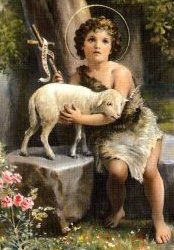
 

Birth of St. John the Baptist (3)

Today we celebrate a little Advent “oasis” in the midst of summer, because we celebrate the birth of the forerunner of Christ, the Messiah: St. John the Baptist. With St. John the Baptist’s birth Israel witnessed the first signs of life after centuries of waiting and hoping for salvation.

In today’s First Reading Isaiah envisions the expectation of St. John the Baptist, even while in his mother’s womb, of the lofty mission to which he has been called—the herald of the Messiah. Israel had shared the same expectation for centuries. All of Israel had been waiting for a sign for centuries. When we read the last books written in the Old Testament, we see signs and wonders that occurred centuries before the event we are celebrating today. After spending their whole life awaiting liberation, Israel in the time of St. John was in the hands of a foreign power: the Romans.

In the midst of this, Zachariah and Elizabeth—St. John’s parents—remind us of the fidelity of Israel, but despite them being blameless in the sight of the Lord, God had not blessed them with children. When something like this happened, the Israelites always assumed it meant those suffering from it were cursed by God. Children were one of the greatest signs of blessing for the Israelites. Amidst Zechariah’s worship “routine” (cf. Luke 1:8-17) the sign came: an angel announces to him the answer to his prayers—he would have a son and named him John—and an old woman shows signs of life in her womb as she becomes a mother. Israel was certainly awaiting something flashier—we all like pyrotechnics and special effects (legions of angels, the ground swallowing people up, armies being overthrown), but Zachariah received the sign in private, while worshiping, and only after a lot of prayer.

In today’s Second Reading Paul reminds us that we celebrate St. John the Baptist’s birth today because he was born to herald the coming of the Messiah. John would be the herald of the Messiah, the last prophet, ushering the Old Testament into the New by announcing that the Kingdom of Heaven was at hand, and Israel needed to get ready. John would be the last and greatest prophet. He would see the Messiah begin his saving mission on earth, and also accept that his mission ended as the Messiah’s was beginning.

Today’s Gospel doesn’t mention the reason for Zachariah being mute, but it’s important to understand the context. When the angel appeared to Zachariah and told him he’d be a father Zachariah answered “How shall I know this? For I am an old man, and my wife is advanced in years” (Luke 1:18). His faith wasn’t strong enough, and he was made a mute witness to everything that was about to happen—he saw the angel’s announcement coming true but was unable to tell anyone about it or what had happened to him.

Even though his faith was weak, God still gave him a chance, as we will see. “His name will be John” (cf. Luke 1:13). Signs will come, but they’re always an invitation to go deeper in our faith: God always puts more faith in us than we do in him—he always gives us another chance. Zachariah took his second chance by supporting Elizabeth’s insistence on the name John. The angel had announced “His name will be John” and Zachariah’s second chance at faith by seconding the angel’s words loosed his tongue. Through his faith Zachariah became involved in God’s immense plan of salvation again, and, in turn, his son John became that sign for Israel that the Messiah was coming.

Let’s ask John the Baptist today to help us see where we might be silent spectators regarding God’s plan. What do I think God’s plans are for my life, my family, my corner of the world? How can I give witness to that plan and second it in my own life? Let’s second God’s plans wholeheartedly, enthusiastically, and joyfully, as Zechariah does today, confident that it will help prepare the way for others to encounter the Messiah.

Readings: Isaiah 49:1–6; Psalm 139:1b–3, 13–15; Acts 13:22–26; Luke 1:57–66, 80. See also Birth of St. John the Baptist (2) and Birth of St. John the Baptist.

11th Sunday in Ordinary Time, Cycle B

Today’s readings remind us that the Kingdom of God has already been sown by Our Lord and continues to grow with us or without us, because it grows due to God’s power, just like nature does. It can grow in and through us too if we cultivate it in our hearts.

In today’s First Reading Ezekiel describes the Messiah as a tender shoot taken off the main tree—the royal stock of David. The Messiah will be established on the heights but will also grow to be tall and sheltering for all those who can reach those heights. Other kings and their lines will look upon the Messiah’s prosperity and realize that it is the Lord who blesses them or lets their lineage fade away, fruitless. Many “birds” will find shelter in this tree, but they must fly very high.

In today’s Second Reading Paul reminds us that the way we use this dying mortal body will determine what it grows into in eternity. Our mortal bodies grow old and die whether we are good or evil, but our eternal life depends on what we do with our earthly life. The seed of eternal life is sown in us through Baptism. We can nurture it and water it with the grace of a holy life, or we can neglect it and focus so much on pleasing a dying earthly body that our eternal life is at risk. Our Lord wants our earthly life to flourish and blossom into something wonderful. We truly grow to the degree that we work with Our Lord’s grace in us.

When Our Lord begins his public ministry the core of his message is that the Kingdom of God is at hand, and conversion and faith in the Gospel are needed. In today’s Gospel he gives us two parables to understand what the Kingdom of God is: the sowing and reaping of grain and the growth of a mustard seed. By teaching in parables he is trying to explain deeper spiritual realities using the everyday realities understood by his listeners.

The Kingdom of God reflects this profundity: it is reflected in the Church and her work, but it also the whole work of salvation, of God conquering hearts, one by one, throughout the centuries, until his reign of love endures forever in the hearts of those who welcomed it. The example of the grain shows us that this requires cultivation, waiting for the right time to reap the spiritual harvest of our labors, but also that God does the heavy lifting. The growth that is quiet, slow, and unseen, at times even when we’re not doing anything, comes from him and from his grace working in our souls and in the souls of others.

The example of the mustard seed shows that it starts small: in Jesus’ earthly ministry it went from him, to twelve disciples, then to thousands by the time narrated in the Acts of the Apostles, and to the whole world and throughout history. The Kingdom doesn’t just represent something small that has an incredible capacity for growth and expansion; like the cool shade of the mustard plant it makes room for everyone to find rest and consolation, because God wants everyone to be saved and to come to a knowledge of the truth.

Today’s Gospel reminds us that Our Lord gave more explanations in private to the disciples: deeper spiritual realities are understood more fully through parables and explanations, but since they ultimately refer back to the deepest mystery–God–they’re never completely fathomable. If a mustard seed, wheat, or cedar can help us fathom the mysteries of God, what other everyday things that we take for granted have the same power? Spend some time this week admiring nature and asking yourself, “what does this creation teach me about its Creator?”

Readings: Ezekiel 17:22–24; Psalm 92:2–3, 13–16; 2 Corinthians 5:6–10; Mark 4:26–34.

10th Sunday in Ordinary Time, Cycle B

Today’s readings remind us that if circumstances make us choose between God’s will and our family, as painful as it may be, we have to choose God’s will.

In today’s First Reading Adam is busted. He put more trust in Eve than in God and Fell. Sacred Scripture does not say Eve duped Adam. She offered him the forbidden fruit and he let doubt about the Lord enter into his heart and sinned. When Adam says it was the woman “whom you put here with me” it’s almost as if he’s accusing the Lord himself of putting him into this situation. Eve tries to pin all the blame on the serpent, but she is an adult, responsible for her own actions. Sin may appear at times as the way to salvage or consolidate a relationship, but it always drives us wedge between us and between us and God. Today’s First Reading shows us that those cracks may not appear at first, but they’re not long in coming.

In today’s Second Reading Paul reminds us God’s will is not that we should choose between him and our family, but that our family should be united in faith. The Lord wants us to do his will because it is good and because it will be a source of abundant blessings for all people of good will. As believers we’re called to share one spirit of faith in Our Lord and in his promise of eternal life. Our Lord acts for our benefit, not against it, and he wants his grace to fill us so much that it “spills out” into grace for more and more people. When we’re faced with the difficulties, frailties, and uncertainty of a Fallen world we must not lose our trust in the Lord and in his promises. Ultimately that spirit of faith is our openness and collaboration with the Holy Spirit.

In today’s Gospel Our Lord encourages us to focus on doing his Father’s will as something good. If we question the motives of God’s actions—Father, Son, or Holy Spirit—trouble awaits. Today’s Gospel invites us to imagine what was going through the mind of Our Lord’s family when news began to reach them of everything happening in his ministry: healings, people mobbing him from all over Palestine, non-stop work that didn’t even leave him time to eat, and an escape by boat as the only way to keep the crowds from flocking around him and following him constantly.

Today’s Gospel says simply that he “came home”; it’s not clear whether he’d come to his house or not, but the mention of the family’s reaction might infer it, although the Gospel only says they heard of what he was doing. The reaction of Our Lord’s family serves to underscore the apparent insanity of the situation, so much that they’re wondering whether Jesus himself is insane. The reaction on the part of the people may seem disproportionate, but it also shows how lost and in need of truth and healing humanity was since the Fall. Since Adam and Eve, all the way to the coming of Our Lord, all generations were lost, and now, in the crazy world that resulted, Our Lord has come to find the lost.

Today’s Gospel is also a strong admonition regarding blasphemy against the Holy Spirit. An unforgivable sin should give pause to anyone, but in this case Saint Mark explains what the Lord is condemning: calling the Holy Spirit an “unclean spirit.” Jesus works his miracles in the power of the Holy Spirit, but the scribes claim the demon Beelzebub is powering his works. A clearer blasphemy is not possible. If we see God’s will as bad, we see him as bad, and that’s not good. That is a sin, just like Adam and Eve at the start of salvation history, and we must reconcile with God and reconcile with his will for us and for all those we love.

Don’t shift the blame to Our Lord this week for anything in your life that is not going as you’d like. Adam and Eve tried to shift the blame for their faults to others. If we accept the blame for what we’ve done the path to reconciliation and peace is opened. The worst tactic is pinning the blame on Our Lord for our sins or the sins of others that have affected us. Our Lord detests sin as much as we do and more. Let’s put the blame where blame is due: on sin.

Readings: Genesis 3:9–15; Psalm 130:1–8; 2 Corinthians 4:13–5:1; Mark 3:20–35.

9th Week in Ordinary Time, Tuesday, Year II

Today’s First Reading invites us to hasten the end of the world as we know it. Why would we want the world to end? It’s not a matter of if; it’s a matter of when. As believers the Lord has promised us, as St. Peter reminds us, “new heavens and a new earth in which righteousness dwells.” If we do want this new world to come St. Peter today also answers the question of, “why wait?”

In the face of so much struggle and evil in the world, why not just end it all? Because of the people who’d be left out. The Lord’s waiting for us, and for others, to welcome the Gospel. The patience of Our Lord is always for the purpose of salvation.

We “hasten” that day by sharing the Gospel and working for the conversion of sinners. Let’s help spread the Gospel so that the Lord’s righteousness reigns.

Readings: 2 Peter 3:12–15a, 17–18; Psalm 90:2–4, 10, 14, 16; Mark 12:13–17. See also 29th Sunday in Ordinary Time, Cycle A and 9th Week in Ordinary Time, Tuesday.