13th Week in Ordinary Time, Tuesday, Year II

Today’s Gospel reminds us that we all experience a moment of panic when storms arise in life and it seems Our Lord is sleeping. In today’s Gospel this storm could even be seen as Our Lord’s fault: he got into the boat first. However, it’s also important to realize that the disciples followed him into the boat; they chose to get into that boat. When we follow Christ storms may arise and it may seem like he is napping, but he is probably testing our faith.

The disciples in today’s Gospel wanted Our Lord to do something. Even panicking would have meant something, but he remained asleep until they woke him. They didn’t think about the fact that Our Lord had got into the boat first; if he was unconcerned, why weren’t they? They would have had a stormy ride, but they would have gotten through it. With the little faith they had they went to Our Lord for a solution and with a few words the storm was gone.

The disciples learned that they had to have more faith. Let’s ask Our Lord as well to help us have more faith in him when things get stormy.

Readings: Amos 3:1–8, 4:11–12; Psalm 5:4b–8; Matthew 8:23–27. See also 12th Sunday in Ordinary Time, Cycle B13th Week in Ordinary Time, Tuesday, and Wednesday after Epiphany.
13th Week in Ordinary Time, Monday, Year II

In today’s Gospel Our Lord reminds us not to worry about where we’re going to stay or our family when we follow him and help him extend his Kingdom. Everything we seek, God willing, will be awaiting us at the end of our journey: true rest and everyone we love in Heaven.

Readings: Amos 2:6–10, 13–16; Psalm 50:16b–23; Matthew 8:18–22. See also 13th Week in Ordinary Time, Sunday, Cycle C, 10th Week of Ordinary Time, Saturday, Year II and 26th Week in Ordinary Time, Wednesday.

13th Week in Ordinary Time, Sunday, Cycle C

A superficial reading of today’s First Reading and Gospel may give us the impression that Elijah is easier on his disciple than Our Lord is with his, but the Second Reading can shed a little light on the apparent difference. Paul reminds us in the Second Reading that life is a battle between the flesh and the Spirit; the Christian life presents a new way of living, living in a way that you are not enslaved to things and situations, but alive in the Spirit and focused on the spiritual goal. Even good things, if sought for the wrong reasons, can oppose a life of the Spirit.

A common denominator in today’s First Reading and Gospel is that the disciple asks to do something before following his master. The subtle difference is that, unlike Elijah, Our Lord can always read hearts and see whether that heart is speaking from the flesh or from the Spirit. Elisha is “liquidating his assets” and doing one last gesture of love for his family before departing; the hearts of disciples in today’s Gospel are only known to Our Lord, and it is in his response to them that we see a potential conflict between Spirit and flesh that he is trying to help them address.

The first disciple in today’s Gospel perhaps doesn’t understand that following Our Lord is a something lifelong: he’s not just headed to the Rabbi’s house instead of his own, he is committed to permanently follow Jesus, just as every Christian is called to do. The second wants to attend to important family business, but sometimes following Our Lord requires sacrifice and self-denial: in telling the dead to bury their dead Our Lord perhaps is telling him too that the family business he is concerned about can already be attended to by another member of his family. The last potential disciple wants to go home and say goodbye first: Our Lord sees something in that request that would put flesh over Spirit. Perhaps the disciple would go home and stay there. Following Christ is the best thing we can do for ourselves and our family, and we must never lose sight of that.

Whatever path Our Lord calls us to walk, not just priesthood or consecrated life, it is a path where we follow him. Let’s ask him today to show us the path we should take and how we should take it.

Readings: 1 Kings 19:16b, 19–21; Psalm 16:1–2, 5, 7–11; Galatians 5:1, 13–18; Luke 9:51–62. See also 10th Week of Ordinary Time, Saturday, Year II and 26th Week in Ordinary Time, Wednesday.

12th Week of Ordinary Time, Saturday, Year II

Today’s First Reading captures the sentiments of the Israelites undergoing the Babylonian Captivity, recalled two days ago. They’re trying to come to grips with why the Lord handed them over to their enemies. What a great contrast with today’s Gospel, when a Roman centurion, part of the people who are occupying Israel centuries after their return from the Babylonian Captivity, is showing more faith in Our Lord and his power to heal than the Lord’s Israelite contemporaries.

Today we live a far different type of “conquest” and expansion. Today, thanks to Our Lord, all of us, whatever our ethnic background, are invited to form a part of the Kingdom of heaven, Christ’s Kingdom, and we pray with every Our Father that it come. That centurion foreshadows all of us with no drop of Jewish blood who met and became disciples of Our Lord and children of God through baptism. The Jews are not excluding from this opportunity, but as Our Lord taught them in today’s Gospel, faith is what will usher them into a lasting Kingdom that is secure from their true enemies: sin and death. Even the healing today of the centurion’s servant is a foreshadowing of the power of Christ the King.

Let’s thank Our Lord today for inviting us to form a part of his Kingdom, and help him to make his kingdom come and reconquer hearts for God.

Readings: Lamentations 2:2, 10–14, 18–19; Psalm 74:1b–7, 20–21; Matthew 8:5–17. See also 12th Week in Ordinary Time, Saturday.

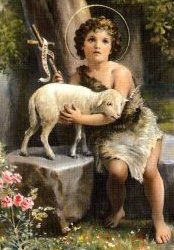
Birth of St. John the Baptist (2)

Today we commemorate the birth of the last Old Testament prophet, but also the prophet who would have the grace of heralding the Messiah. This solemnity, a few months after the Annunciation, remembers the first rays of the dawn of hope that became Our Savior. John, like Mary, is the first rays of a new life that would be restored and one day achieve fullness in Christ. As the First Reading reminds us today he, like Our Lord, would have suffering in the fulfillment of his mission for the sake of the Messiah.

John would be beheaded in prison before Our Lord carried out the work of redemption on the Cross, but the First Reading also reminds us that he would receive his reward and recompense for his service. Even as we celebrate John’s birth today, we also remember his birth into Heaven after successfully completing his mission for the benefit of us all. Even Paul, as today’s Second Reading reminds us, could not forget the role of John, and in many moments of the Acts of the Apostles the disciples encounter those who have only known John, happily baptizing them in Jesus’ name to complete their reconciliation with God.

John is involved in our mission as disciples of Christ, even today. Let’s pray for his intercession on his birthday so that our own mission to herald the Messiah is fruitful.

Readings: Isaiah 49:1–6; Psalm 139:1b–3, 13–15; Acts 13:22–26; Luke 1:57–66, 80. See also Advent, December 23rd and Birth of St. John the Baptist.