19th Week in Ordinary Time, Friday, Year II

In today’s First Reading the Lord describes his relationship with Israel as that of discovering an infant abandoned at birth and marrying her when she came of age and showering every finery on her, only to have his love rejected by her adultery and insensitivity to all he had done for her. The Lord responds to this infidelity by promising to take her as his spouse not just while she lives, but forever: his response to her lack of love is an everlasting and forgiving love, a love so unbelievable that it would throw her into shame and confusion over how she had mistreated him.

In today’s Gospel the Pharisee’s are looking for ways to send away a wife, not how to save a marriage. Sadly today for many divorce seems to be the only option because what your spouse has done or failed to do seems unforgivable. That is the moment to show your love. While the Lord promised this forgiving and everlasting love in the First Reading, Jesus showed it on the Cross. We have a love to imitate and a love to strengthen us when love and forgiveness seems impossible: the love of God.

Every spouse promises unconditional love the day of their wedding. Let’s pray that when that unconditional love is put to the test can be kindled again with Our Lord’s help for both spouses through forgiveness.

Readings: Ezekiel 16:1–15, 60, 63; Isaiah 12:2–3; Matthew 19:3–12. See also 27th Sunday in Ordinary Time, Cycle B and 19th Week in Ordinary Time, Friday.
 

19th Week in Ordinary Time, Thursday, Year II

In today’s Gospel Our Lord teaches us that math and mercy should not mix. You either forgive someone or you don’t. Peter’s question is really asking how much mercy is too much, and Our Lord responds that mercy is measured by whether it is from the heart, not by how much is forgiven. If you continue to measure mercy you are straying into the field of justice, and justice is exacting and unforgiving. The Heavenly Father is pleased by our mercy, but he also respects our decision when we want to follow the path of justice instead.

The servant in today’s parable was offered mercy, but chose the path of justice instead. In showing a desire for justice from his neighbor for a much smaller debt he showed that justice, at least when it involved him, was more important than mercy, and as a result every penny of an impossible sum would be exacted from him. Peter would deny knowing Our Lord three times, but Our Lord forgave him completely.

Let’s forgive and seek forgiveness from the heart, not from mental math.

Readings: Ezekiel 12:1–12; Psalm 78:56–59, 61–62; Matthew 18:21–19:1. See also 3rd Week of Lent, Tuesday and 19th Week in Ordinary Time, Thursday.

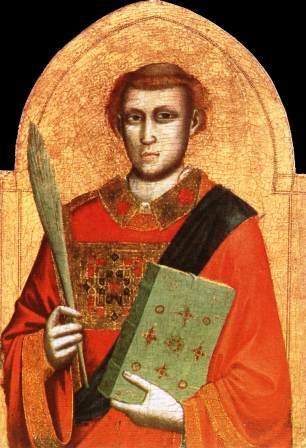
St. Lawrence, Deacon and Martyr (2)

When a grain of wheat is planted and dies, it doesn’t stop being wheat. It becomes something greater through fulfilling the purpose for which it was created. When the grain is not planted, it remains small and insignificant, and it doesn’t achieve all its potential. Our Lord in today’s Gospel uses this example when he is told that some Greeks would like to meet him. His Passion is close, and even those beyond the confines of Israel would benefit from it, like the Greeks, but it would require that he be planted on the Cross and die in order to achieve salvation.

If a grain of wheat could feel it’s destruction in order to provide new growth and purpose, it would be an agony. Our Lord also chooses this process to describe what spiritual growth is like, not just in the case of martyrdom. Mortification is a process of “deadening” yourself to the things of this world in order to become detached from them and able to focus and use them for greater spiritual goods. However, everyone knows that this process of deadening, especially at the beginning, feels like dying: detachment means un-attaching yourself to something you’ve been stuck on for a long time, and that’s not easy. In the very moment you try to pull away you achieve a greater insight into how enslaved you really are and how much you are in need of liberation.

This process is not necessarily always done for spiritual reasons: many people sacrifice themselves for a higher purpose, even a noble one. St. Lawrence and Our Lord remind us that martyrdom is a supreme sacrifice for love of God and of souls. It is not just death; it is service and transformation. Even if we’re not called to martyrdom, let’s resolve to live less for the world and more for God and for others.

Readings: 2 Corinthians 9:6–10; Psalm 112:1–9; John 12:24–26. See also St. Lawrence, Deacon and Martyr and 11th Week in Ordinary Time, Wednesday.

19th Week in Ordinary Time, Tuesday, Year II

In multiple Gospel accounts the disciples debated among themselves who is the greatest and how to become so, but today they have the openness to ask Our Lord, and he tells them that if they don’t have the attitude of children they won’t even make it into the Kingdom of Heaven. Through Baptism we are adopted as sons and daughters of God; we become his children, and a good child seeks to please his or her Father in everything, and counts on his or her Father to provide everything he or she needs.

If acting like a child of God is necessary to enter the Kingdom of Heaven, Our Lord reminds us today that having the humility of a child is a measure of greatness in the Kingdom. Humility is one of the most precious virtues in the eyes of God: it flies in the face of earthly ambition and vainglory. Alongside humility greatness in the Kingdom is measured by our dedication to even its smallest member. Children were accepted in Our Lord’s time, but not often appreciated. It’d be easy to argue that writing off one sheep out of hundred is okay, but Our Lord invites the disciples to show a greater level of dedication, letting no one be lost.

Let’s ask Our Lord to help us not only form a part of his Kingdom, but to be great in his eyes through our humility and dedication.

Readings: Ezekiel 2:8–3:4; Psalm 119:14, 24, 72, 103, 111, 131; Matthew 18:1–5, 10, 12–14. See also The Guardian Angels25th Sunday in Ordinary Time, Cycle B, and 19th Week in Ordinary Time, Tuesday.

19th Week in Ordinary Time, Monday, Year II

After a dire reminder to his disciples of his impending Passion a conversation on taxation and a miracle pay-off seems somewhat banal, but if we scratch below the surface we see something a little deeper. The translation used in liturgy speaks of the king’s “subjects” being exempt from paying taxes, but the more literal translation of the original Greek is “sons.” Our Lord shouldn’t be expected to pay the Temple tax because it is the House of his Father. However, he knows that those asking for the tax probably don’t believe that he is the Son of God, so he accedes to their request.

The miracle to pay the tax is almost comical, but it shows that not only the Temple, but all of Creation is the Lord’s house. Our Lord knows his home down to a coin in a fish in hidden in the sea because he knows his Creation and he has made it his home. It makes the tax collectors’ request even more insignificant, but it also underscores the grandeur of Our Lord who is not shy about condescending to such a simple request.

Our Lord is so simple and humble that in his closeness to us he rarely needs to remind us of how majestic he is. Let’s not lose sight of that and adore him as he deserves.

Readings: Ezekiel 1:2–5, 24–28c; Psalm 148:1–2, 11–14; Matthew 17:22–27.