20th Week in Ordinary Time, Wednesday, Year II

Today’s readings presents two images of leadership, one good and another bad, and tries to show the qualities of a good leader. Sheep need a shepherd in order to be fed, protected, and healthy; they cannot easily survive on their own. In the First Reading the Lord describes the poor leaders of Israel as bad shepherds who mistreat and exploit the very sheep they should nourish and protect. He promises to shepherd them personally instead, a promise he would keep through the Good Shepherd who’d lay down his life for his sheep.

In the Gospel Our Lord gives the example of a benevolent employer, but more to describe God’s goodness in rewarding those who enter his Kingdom, whether from the beginning of their lives or at the last minute. Whether they began in his service early or late, the employer out of his goodness and mercy provides what they need to live; he doesn’t try to squeeze more work out of them with raises that they don’t need, nor does he penalize them for being late hires. Unlike the bad shepherds of the First Reading, the benevolent employer focuses on the good of his workers, not what they can do for him. He puts people before profit.

Our Lord doesn’t need our collaboration and service, yet he blesses us when we help him. Let’s thank Our Lord for all the blessings he has showered on us by being good sheep, good workers, good shepherds, or good employers. In short, let’s do well in whatever vocation he has given us.

Readings: Ezekiel 34:1–11; Psalm 23:1–6; Matthew 20:1–16. See also Solemnity of the Sacred Heart of Jesus, Cycle C, and 20th Week in Ordinary Time, Wednesday.
20th Week in Ordinary Time, Tuesday, Year II

In today’s First Reading the Lord warns the rich man against becoming so enamored of his wealth that he grows conceited, with delusions of divinity and becoming an island with regard to others. The reality faced in Ezekiel’s time was that the wealth and security of the “prince of Tyre” were under threat and easily destroyed, along with the man’s very life, and all the money in the world wouldn’t spare him.

Our Lord in today’s Gospel is not exagerating when he says it is easier for a camel to pass through a needle’s eye that it is for someone rich to enter the Kingdom of heaven. With wealth it seems like you have everything you could ever want, yet wealthly people many times are miserable even though they are surrounded by opulence. Their wealth can make them into islands, separating them from family and friends. Wealth is not bad on its own, but it always bears the risk of making you stop searching for the needs that money cannot buy.

Any business person will tell you it’s not a question of having money that determines success, but how wisely it is invested. Like any other creature it can separate you from God and from others or it can help you to draw closer to them. Ask Our Lord to help you review your balance sheet and see whether you’re investing in a good and holy life. The returns are out of this world.

Readings: Ezekiel 28:1–10; Deuteronomy 32:26–28, 30, 35c–36b; Matthew 19:23–30. See also 20th Week in Ordinary Time,Tuesday, 8th Week of Ordinary Time, Tuesday, Year II, and 8th Week in Ordinary Time, Tuesday, Year I.

Assumption of the Blessed Virgin Mary (2)

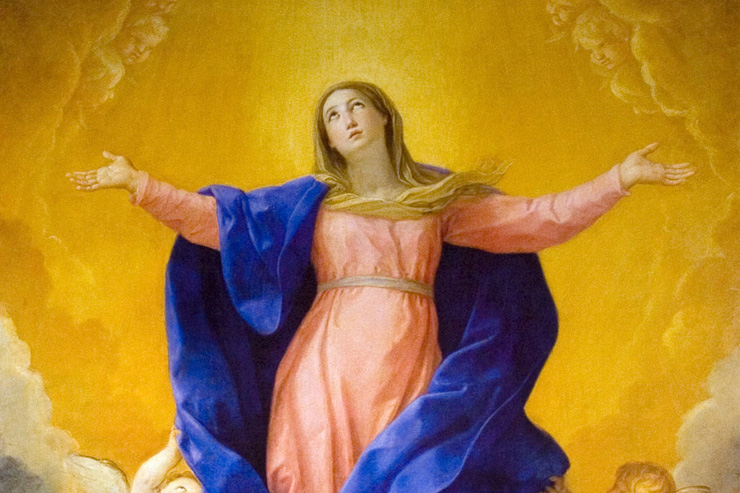
Today we celebrate Mary being taken up, body and soul, into Heaven at the end of her life here on earth. She reminds us today that life is not truly taken away; it simply changes and, for those who have persevered in the faith like Mary, it blossoms into an eternal and glorified life: in the Eastern Churches this solemnity is known as the Feast of the Dormition, commemorating when Mary simply went to sleep.

Mary’s Assumption consoles us with the confidence that those who face the end of the earthly phase of their life have nothing to fear if they have lived it well. Even if they haven’t lived it well, when the end of life here below comes all they have to do is entrust themselves to the Lord’s mercy and they’ll have nothing to fear. Christian faith and hope in the Resurrection and eternal life help us and our loved ones to face the end of life here below with serenity, no matter how tragic the circumstances.

Our Blessed Mother has simply moved, and, as so many apparitions attest, she is still very active in making sure all her children will join her one day, body and soul, in Heaven. Through Mary’s intercession let’s pray for the grace of a good life and for the grace of a Christian hope that doesn’t fear death.

Readings: Revelation 11:19a, 12:1–6a, 10ab; Psalm 45:10–12, 16; 1 Corinthians 15:20–27; Luke 1:39–56. See also Visitation of Mary, 4th Sunday of Advent, Cycle CAdvent, December 22nd, Advent, December 21st, and Assumption, Cycle B.

20th Week in Ordinary Time, Sunday, Cycle C

Today’s First and Second Readings show the two extremes in which a believer be found in serving Our Lord by sharing his message: alone and abandoned in the mud at the mercy of evil and injustice, or spurred on by the example and help of a “cloud of witnesses” who show that the path of belief is the right one. We all experience moments in the mud and moments enthused by our faith and that of our fellow believers.

Jeremiah in today’s First Reading was the victim of the very division that Our Lord would later forewarn his disciples, yet Jeremiah in the end was rescued through the intercession of just men. When we face division and strife over transmitting the Gospel we should not become discouraged, because Our Lord suffered such things first, as well as many believers who came before us. In moments of enthusiasm we mustn’t forget that there will be moments of the Cross, but in moments of the Cross we should be bolstered by memories of our moments of enthusiasm.

In all circumstances we need Our Lord’s help, just not in the same way. Let’s ask him to help us in fair weather or foul.

Readings: Jeremiah 38:4–6, 8–10; Psalm 40:2–4, 18; Hebrews 12:1–4; Luke 12:49–53. See also 15th Week in Ordinary Time, Monday, Year II29th Week in Ordinary Time, Thursday, and 15th Week in Ordinary Time, Monday.


19th Week in Ordinary Time, Saturday, Year II

In today’s First Reading the Lord scolds those who believe children are simply the victims or beneficiaries of their parents’ actions and nothing more. The Israelites had adopted a “born to lose” mentality that was not the plan of the Lord. Parent and child would be responsible for their own actions. Sadly today for many parents children are seen as the fruit of mistakes they’ve made: children are lucky to be born in a society that only wants them when convenient and tries to prevent them from coming to term when they’re not.

Our Lord wants to bless children to show us that they are a blessing. He wants them to be born, to come to him in Baptism, and to lead holy and happy lives. We must not be an obstacle to that, nor should we permit society to do so. We help them approach Our Lord by letting them live their childhood in innocence and not letting society rob them of it.

Let’s pray and work so that every child is born, is loved, and is helped to know and experience Our Lord.

Readings: Ezekiel 18:1–10, 13b, 30–32; Psalm 51:12–15, 18–19; Matthew 19:13–15.